



鲍鱼是软体动物门(Mollusca)、腹足纲(Gastropoda)、前鳃亚纲(Prosobranchia)、原始腹足目(Archaeogastropoda)、鲍科(Haliotidae)、鲍属(Haliotis)的统称,其肉质嫩滑,滋味鲜美,在我国素有“海产八珍之冠”的美誉[1]。2020年,我国鲍鱼养殖产量达20.3×10⁴ t,主要分布于福建、山东、广东、辽宁等省份,其中福建鲍鱼产量最大,为15.5×10⁴ t,占全国产量的80%左右[2-3]。鲍鱼加工过程会产生大量下脚料,如鲍鱼内脏、鲍鱼壳等,而鲍鱼内脏占鲍鱼总重量的20%~30%,并且含有丰富的蛋白质、氨基酸、脂肪及碳水化合物,具有多种功能活性组分[4⇓-6]。研究表明,海洋生物中的脂类组分具有很好的开发和应用潜力[7]。楼乔明等[8]分析了皱纹盘鲍内脏的脂质成分及其脂肪酸组成,发现总脂肪酸以C20∶4n-6和C20∶5n-3等多不饱和脂肪酸为主,且富含缩醛甘油酯,具有较高的营养价值和保健开发潜力。刘艳青等[9]发现皱纹盘鲍内脏中磷脂含量可达31.58%,不饱和脂肪酸在磷脂中含量显著高于中性脂质含量。陈贝等[10]还发现皱纹盘鲍内脏脂质可显著降低HepG2总胆固醇和甘油三酯含量,同时能显著降低HepG2细胞脂肪酸合成相关基因SREBP1c、ACC1、FAS和脂肪酸转运吸收相关基因CD36mRNA的表达水平,提高线粒体脂肪酸氧化基因CPT1的表达水平。本研究以皱纹盘鲍(Haliotis discus hannai)内脏为原料,分别研究石油醚提取法和乙醇提取法对鲍内脏脂类的提取效果和脂肪酸组成差异,为鲍脂类的开发利用提供理论和技术依据。
1 材料与方法
1.1 实验材料
1.1.1 原料与试剂
皱纹盘鲍内脏来源于厦门市岛之原生物科技有限公司,将其绞碎匀浆,冷冻干燥后粉碎,过50目筛,密封保存备用;脂肪酸标准品,美国Sigma公司;分析纯95%乙醇、石油醚和大孔树脂D101,国药集团化学试剂有限公司。
1.1.2 仪器设备
MA100水分测定仪,德国赛多利斯股份有限公司;Kjeltec 8400凯氏定氮仪,丹麦福斯分析仪器公司;Agilent 6890型气相色谱,安捷伦科技有限公司;Specter AA220石墨炉原子吸收仪,美国瓦里安(中国)有限公司;PE-2280火焰原子吸收仪,珀金埃尔默股份有限公司。
1.2 实验方法
1.2.1 鲍内脏营养成分分析
采用常压干燥法(GB 5009.3—2016《食品安全国家标准 食品中水分的测定》)测定鲍内脏中的水分;分别参照国家标准GB 5009.5—2016《食品安全国家标准 食品中蛋白质的测定》、GB 5009.6—2016《食品安全国家标准 食品中脂肪的测定》、GB/T 9695.31—2008《肉制品 总糖含量测定》、GB 5009.4—2016《食品安全国家标准 食品中灰分的测定》中规定的方法对鲍内脏中的粗蛋白、粗脂肪、碳水化合物和灰分进行测定。
1.2.2 鲍内脏脂类的提取
参照陈贝等[10]方法进行脂肪的提取。以鲍内脏为原料,分别利用石油醚和95%乙醇作为溶剂,在35℃进行索氏萃取2次,每次3 h。分别采用颗粒状和粉末状活性炭对提取脂肪进行脱色处理,并利用大孔树脂D101进行纯化获得鲍脂肪。
1.2.3 脂肪酸组成分析
取鲍内脏脂类,甲酯化法处理后,参照GB 5009.168—2016《食品安全国家标准 食品中脂肪酸的测定》的方法,分析脂肪酸的组成及含量。
1.2.4 脂肪酸营养指标分析
式中:UFA (Unsaturated fatty acid)为不饱和脂肪酸;MUFA(Monounsaturated fatty acid)为单不饱和脂肪酸;PUFA(Polyunsaturated fatty acid)为多不饱和脂肪酸;n-3 PUFA(Omega-3 polyunsaturated fatty acid)为 n-3型多不饱和脂肪酸;n-6 PUFA(Omega-6 polyunsaturated fatty acid)为 n-6 型多不饱和脂肪酸。
1.3 数据处理
实验数据采用SPSS 19.0软件进行统计分析,单因素方差(One way ANOVA)分析方法分析组间差异。采用The Origin 2022进行数据处理和绘图。
2 结果与分析
2.1 皱纹盘鲍内脏主要营养成分分析
对皱纹盘鲍内脏中主要营养组分进行测定,结果如表1所示,皱纹盘鲍内脏中含有丰富的脂肪,含量达5.88%,占鲍内脏干物质的21.8%,远高于鲍肌肉中的脂肪含量。因此,内脏是鲍主要的油脂原料来源。此外,鲍内脏中蛋白质含量为13.90%,碳水化合物为5.82%,表明鲍内脏是一类高脂、高蛋白和高多糖的原料。
表1 皱纹盘鲍内脏主要营养成分
Tab.1
| 主要营养成分 Main nutritional components | 鲍内脏 Abalone viscera | 鲍肌肉[15] Abalone muscle |
|---|---|---|
| 水分 Moisture | 72.40 | 81.24 |
| 蛋白质Protein | 13.90 | 14.59 |
| 粗脂肪 Fat | 5.88 | 0.11 |
| 碳水化合物 Carbohydrate | 5.82 | 3.92 |
| 灰分 Ash | 2.32 | 0.57 |
2.2 皱纹盘鲍内脏脂类提取研究
不同溶剂对鲍脂类的得率和脂肪酸组成具有显著影响[16]。此外,应用活性炭能有效地进行脂类的脱色脱臭,提高产品质量。本研究分别运用石油醚和乙醇进行鲍内脏脂类提取,并分析颗粒活性炭和粉末活性炭对鲍得率的影响。
由图1可知,在相同条件下,以石油醚为溶剂进行索氏萃取鲍脂类,其中,用颗粒活性炭吸附法的得率是(1.18±0.07)%,粉末活性炭吸附法的得率是(0.90±0.13)%,颗粒活性炭吸附法的提取率比粉末活性炭吸附法的提取率增加21.1%。其原因可能是粉末活性炭比表面积大,对油脂的吸附能力大,从而降低了鲍内脏脂类的提取率。在相同条件下,以乙醇为溶剂进行索氏萃取鲍脂类,其中,颗粒活性炭吸附法的得率为(1.89±0.43)%,粉末活性炭吸附法的得率为(1.66±0.31)%,颗粒活性炭吸附法的得率比粉末活性炭吸附法的得率增加13.86%。综合比较,以得率作为指标,以乙醇为溶剂的鲍内脏脂类提取方法优于石油醚提取法。
图1
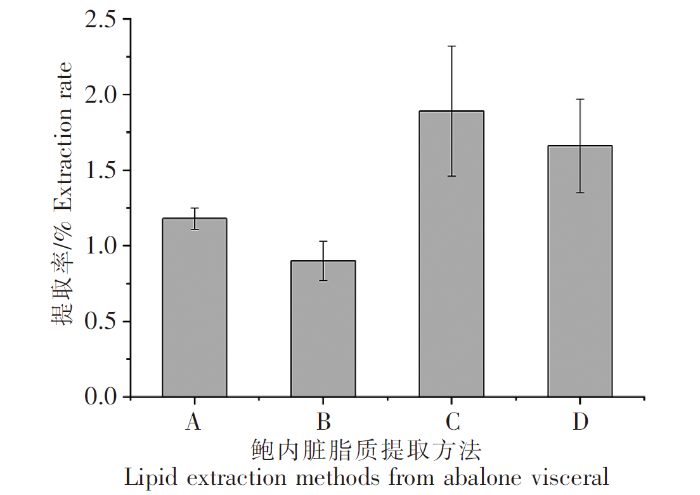
图1
不同提取方法皱纹盘鲍内脏脂类提取率测定
注:A.石油醚提取+颗粒活性炭法;B.石油醚提取+粉末活性炭法;C.乙醇提取+颗粒活性炭法;D.乙醇提取+粉末活性炭法。
Fig.1
Lipid extraction rate of Haliotis discus hannai viscera with different extraction methods
Notes:A.Petroleum ether+activated carbon(granulated);B.Petroleum ether+activated carbon(powder);C.EtOH+ activated carbon(granulated);D.EtOH+activated carbon(powder).
2.3 皱纹盘鲍内脏脂类的脂肪酸组成分析
分别对石油醚提取法和乙醇提取法提取的皱纹盘鲍内脏脂类的脂肪酸组成进行分析,结果如表2所示:石油醚提取法和乙醇提取法提取的鲍内脏脂类分别被检测出16种和19种脂肪酸,UFA含量[30.98%(石油醚提取法)、44.76%(乙醇提取法),以下同此]均高于饱和脂肪酸(Saturated fatty acid,SFA)含量(20.45%、29.74%),其中石油醚提取法和乙醇提取法分别被检测出5种和6种SFA,分别占总脂肪酸的39.34%和39.53%,以直链饱和脂肪酸C16∶0(13.7%、18.85%)、C14∶0(2.96%、6.55%)和C18∶0(2.11%、2.23%)为主;均被检测出4种MUFA,分别占总脂肪酸的24.24%和29.79%,以C18∶1n-9(9.45%、16.61%)为主;分别被检测出6种和8种PUFA,分别占总脂肪酸的35.36%和29.71%,以C20∶5n-3(9.51%、8.12%)和C20∶4n-6(7.46%、5.62%)为主,高浓度的C20∶5n-3(EPA)是海洋来源脂类的标志性脂肪酸。石油醚提取法MUFA含量低于PUFA含量,而乙醇提取法MUFA含量与PUFA含量比例接近。石油醚提取的n-3 PUFA含量和n-6 PUFA含量和乙醇提取的分别占总脂肪酸的(18.45%、16.91%)和(15.17%、14.54%);n-3 PUFA与n-6 PUFA比值分别为1.09和1.04,高于FAO/WHO推荐的 n-3/n-6 日常膳食比值(0.10~0.20),表明鲍内脏脂类具有较高的膳食营养价值。
表2 皱纹盘鲍内脏脂类主要脂肪酸组成
Tab.2
| 脂肪酸 Fatty acids | 石油醚提取法/% Petroleum ether extraction | 乙醇提取法/% Ethanol extraction | ||
|---|---|---|---|---|
| C12∶0 | 0.09 | 0.30 | ||
| C14∶0 | 2.96 | 6.55 | ||
| C15∶0 | 0.93 | 0.96 | ||
| C16∶0 | 13.70 | 18.85 | ||
| C17∶0 | 0.66 | 0.74 | ||
| C18∶0 | 2.11 | 2.23 | ||
| C20∶0 | ND | 0.11 | ||
| C14∶1 | 0.12 | 0.30 | ||
| C16∶1 | ND | 2.95 | ||
| C16∶1n-7 | 1.74 | ND | ||
| C18∶1n-9 | 9.45 | 16.61 | ||
| C20∶1n-9 | 1.29 | 2.55 | ||
| C18∶2n-6(LA) | 0.54 | 3.06 | ||
| C18∶3n-3(α-ALA) | 0.08 | 0.40 | ||
| C20∶2n-6 | 0.22 | 0.84 | ||
| C20∶3n-6(DGLA) | 0.57 | 0.73 | ||
| C20∶n-6(ARA) | 7.46 | 5.62 | ||
| C22∶4n-6 | ND | 0.69 | ||
| C20∶5n-3(EPA) | 9.51 | 8.12 | ||
| C22∶5n-3(DPA) | ND | 2.89 | ||
| C22∶6n-3(DHA) | ND | ND | ||
| C18∶1t | 0.37 | 0.58 | ||
| C18∶2t | 0.18 | 0.15 | ||
| ∑FA | 51.98 | 75.23 | ||
| ∑SFA | 20.45 | 29.74 | ||
| ∑MUFA | 12.60 | 22.41 | ||
| ∑PUFA | 18.38 | 22.35 | ||
| ∑trans FA | 0.55 | 0.73 | ||
| ∑ SFA/∑ FA | 39.34 | 39.53 | ||
| ∑ MUFA/∑ FA | 24.24 | 29.79 | ||
| ∑ PUFA/∑ FA | 35.36 | 29.71 | ||
| ∑n-3 PUFA | 9.59 | 11.41 | ||
| ∑n-6 PUFA | 8.79 | 10.94 | ||
| ∑n-9 PUFA | 10.74 | 19.16 | ||
| ∑n-3 PUFA/∑ FA | 18.45 | 15.17 | ||
| ∑n-6 PUFA/∑ FA | 16.91 | 14.54 | ||
| ∑n-9 PUFA/∑ FA | 20.66 | 25.47 | ||
| ∑n-3 PUFA/∑ n-6 PUFA | 1.09 | 1.04 | ||
注:ND:未检出。FA为总脂肪酸。
Notes:ND indicated not check out.FA was total fatty acid.
2.4 不同提取工艺的皱纹盘内脏脂类的脂肪酸营养评价
对鲍内脏脂类的脂肪酸组成进行营养分析与评价,可以为鲍油脂的开发利用提供参考依据。动脉粥样硬化指数AI、血栓形成指数TI、促进健康指数HPI和不饱和指数UI表征了促血栓形成FA(C12∶0、C14∶0和C16∶0)和抗血栓形成FA(MUFA和n-3 PUFA、n-6 PUFA)在血栓形成方面的潜在影响。食用具有较低AI、TI和较高HPI、UI的食物或产品可以降低人血浆中总胆固醇和低密度脂蛋白胆固醇(LDL-C)的水平,对心血管健康有益。低胆固醇血症/高胆固醇脂血症指数(HH指数)与血液胆固醇水平具有一定的相关性[14]。
不同工艺提取脂类脂肪酸的营养指标如表3所示。石油醚提取法皱纹盘鲍内脏脂肪酸的AI、TI值明显低于乙醇提取法,HPI、UI和HH指数明显高于乙醇提取法,表明石油醚提取的鲍内脏脂类可能在脂肪酸营养组成上具有更好的比例。与其他膳食食物相比,石油醚和乙醇两种方法提取的皱纹盘鲍内脏脂类脂肪酸的AI值(分别为0.83、1.01)高于鸡肉(0.372~0.390)[17]、绵羊肉(0.49~0.52)[18]、栉孔扇贝(0.31~0.37)[19]、罗非鱼肉(0.55~0.60)[20]、罗氏海盘车性腺(0.81)[8]和粉红虾肌肉(0.71~0.82)[21];TI值(分别为0.47、0.54)高于罗氏海盘车性腺(0.29)、栉孔扇贝(0.13~0.17)、粉红虾肌肉(0.21~0.30)等海洋来源虾、贝类,但低于鸡肉(0.755~0.784)、罗非鱼肉(0.82~0.87)和绵羊肉(1.1~1.15)等淡水鱼类、陆生禽畜牧肉类;HPI值(分别为1.21、0.99)较牛奶(0.47~0.78)[22]更高;UI值(分别为179.80、151.39)高于猪肉(111~124)[23],表明其具有较好的不饱和程度及常温流动性;HH指数值(分别为1.66、1.52)与尼罗吴郭鱼肉(1.56~1.63)[20]相近,低于鸡肉(2.658~2.786)[24]和羊肉(1.92)[25]。因此,鲍内脏脂肪酸具有良好的AI、TI、HPI、UI和HH指数值,预测其可能在降血脂、软化血管、抑制冠心病和抵抗血栓形成等心血管疾病预防和治疗方面具有一定的功效,可进一步进行开发应用。
表3 皱纹盘鲍内脏脂类脂肪酸营养指数分析
Tab.3
| 指数Index | 石油醚提取法 Petroleum ether extraction | 乙醇提取法 Ethanol extraction |
|---|---|---|
| 致动脉粥样硬化指数 AI | 0.83 | 1.01 |
| 血栓形成指数 TI | 0.47 | 0.54 |
| 促进健康指数 HPI | 1.21 | 0.99 |
| 不饱和指数 UI | 179.80 | 151.39 |
| 低胆固醇血症/高胆固醇脂血症指数 HH | 1.66 | 1.52 |
3 结论
不同提取溶剂对脂类提取具有不同的提取效果。本研究中采用石油醚提取法和乙醇提取法提取鲍内脏脂类,得率分别为(1.18±0.07)%和(1.89±0.43)%。对其脂肪酸组成进行分析,结果发现,鲍内脏脂类中含有较高的UFA。石油醚提取法提取的鲍内脏脂类UFA共有11种,占44.76%,其中MUFA 4种,占12.60%;PUFA 6种,占18.38%。乙醇提取的鲍内脏脂类UFA共有11种,占44.76%,其中MUFA 3种,占22.41%;PUFA 7种,占22.35%;对脂肪酸营养指数进行分析,结果表明鲍内脏脂肪酸具有良好的AI、TI、HPI、UI和HH指数值,预测其可能具有良好的营养和功能价值。
参考文献
福建鲍几种养殖模式浅析
[J].
福建是全国鲍养殖主产区,近年来,随着鲍产业的发展,福建鲍养殖产业存在的问题逐渐凸显出来。本文总结了福建鲍的陆基工厂化养殖、浅海养殖、“南北接力”养殖和离岸设施养殖等4种模式,并对4种养殖模式进行对比分析,以期改进养殖管理,推动福建鲍养殖产业健康发展。
鲍内脏蛋白肽抗氧化和免疫调节活性
[J].以鲍内脏为原料,通过碱性蛋白酶酶解,结合超滤方法,制备了鲍内脏蛋白肽样品。经高效液相色谱 检测,分子质量主要分布在192~938 Da,占比76.3%。鲍内脏蛋白肽具有一定的体外自由基清除能力,对1,1-二 苯基-2-三硝基苯肼自由基的最大清除率为32.7%,对羟自由基清除率的半抑制浓度为2.1 mg/mL,对自由基的 清除效果远低于VC。鲍内脏蛋白肽具有较好的体内抗氧化活性,能极显著增强受伤小鼠体内超氧化物歧化酶 (superoxide dismutase,SOD)活力和提高还原型谷胱甘肽(reduced glutathione,GSH)含量,明显降低丙二醛 (malonaldehyde,MDA)和蛋白质羰基含量,鲍内脏蛋白肽中剂量组SOD活力和GSH含量分别提高了33.2%和 1.3 倍,MDA和蛋白质羰基含量分别降低43.9%和40.7%,其效果已接近或超过了阳性对照的水平,且呈现一定的剂 量效应关系。免疫活性实验结果表明,与空白对照组相比,鲍内脏蛋白肽中剂量组小鼠足跖增厚提高了77.1%,抗 体水平提高了28.0%,脾脏指数提高24.9%,胸腺指数提高了1.2 倍,鲍内脏蛋白肽可以从细胞免疫、体液免疫、非 特异性免疫、免疫器官4 个方面增强小鼠免疫功能,且效果优于阳性对照。
海洋棘皮动物脂质的研究进展
[J].棘皮动物因其油脂中含有许多独特的功能和活性物质,而成为开发保健食品和海洋药物的重要资源之一。目前海洋油脂研究主要集中在鱼油上,而对海洋棘皮动物油脂的研究很少。脂肪酸是海洋棘皮动物中重要的生物活性物质,具有降血脂、抗癌、抗炎等功能活性。因此,本文根据国内外的研究进展对海洋棘皮动物脂质的提取、分离纯化、生物活性等方面进行了概述,以期为海洋棘皮动物的综合利用奠定基础,进而为更好地开发新型海洋食品、药品提供科学依据。
Coronary heart disease:Seven dietary factors.
[J].
Physical and sensory properties of dairy products from cows with various milk fatty acid compositions.
[J].
Lipid compositional correlates of temperature-adaptive interspecific differences in membrane physical structure
[J].
Nutritional indices for assessing fatty acids:A mini-review
[J].
Fatty acid profile,antioxidative status and dietary value of the breast muscle of broiler chickens receiving glycine-Zn chelates
[J].
Carcass traits and meat fatty acid composition of Barbarine lambs reared on rangelands or indoors on hay and concentrate
[J].The objective of this study was to compare carcass and meat quality between Barbarine lambs raised on rangelands and those reared indoors. A total of 24 weaned male lambs (23.2 kg) were allotted into two groups. The first group (GS) grazed pasture dominated by natural shrubs and was supplemented with 100 g of concentrate. The second group (HS) received oat hay and 200 to 300 g supplement of the same concentrate in order to obtain the same average daily gain (ADG) as the GS group. Six lambs from each group were slaughtered. Lambs to be slaughtered were randomly identified at the beginning of the trial. Carcass traits (offals percentage, dressing percentage, cuts yield, tissue composition, fatness and conformation) were determined; pH and meat and fat color were measured. Samples from longissimus lumborum were collected to analyze fatty acid composition. The GS group was characterized by a higher offals percentage, associated with higher lungs, heart, liver and kidney percentage. Carcass dressing percentage defined as the rate between hot carcass weight and empty BW was lower by 3.4% in the GS group. No differences were observed for carcass meat yield and carcass and leg compactness. Shoulder bone percentage of the GS group was higher, without differences in fat and lean percentages. Fat thickness, kidney and tail fats were lower in the GS lambs. However, intramuscular fat content was not affected. Percentages of saturated fatty acids and polyunsaturated fatty acids (PUFA) were not modified, whereas levels of n-3 and long n-3PUFA (EPA, DPA and DHA) as well as Δ5 desaturase plus Δ6 desaturase index were higher for the GS group. Thrombogenic and atherogenic indexes were not altered. No significant effects were observed for meat pH, meat and fat color. Despite having the same ADG, lambs from the GS group were less fatty, and their meat was richer in beneficial fatty acids.
Seasonal variation of proximate composition and lipid nutritional value of two species of scallops(Chlamys farreri and Patinopecten yessoensis)
[J].
Quantification of essential fatty acids and assessment of the nutritional quality indexes of lipids in tilapia alevins and juvenile tilapia fish(Oreochromis niloticus)
[J].
Effects of smoking and sun-drying on proximate,fatty and amino acids compositions of Southern pink shrimp(Penaeus notialis)
[J].Traditional techniques of smoking and sun drying were investigated to understand their effects on nutritional qualities of Southern pink shrimp against present human dietary needs. Shrimps subjected to hot smoking at 71 °C and sun drying at ambient temperature of 31 °C treatments were compared to fresh samples. Proximate composition dry weight basis showed that smoked product were highest in protein and carbohydrate (P < 0.05) while fat was raised in sundried products (P < 0.05). The monounsaturated fatty acid (MUFAs) were highest ranging from 35.87 to 40.35 % in all products. Oleic acid (18:1) had highest value of 24.26 % in the smoked. Eicosapentanoic acid (C20:5 n-3) was highest in the sundried while Docosahexaenoic acid (C22:6 n-3) predominated in the fresh. The shrimp protein had Glutamate as the most abundant amino acid in the three forms. Both preservation methods significantly (P < 0.01) raised the values of tyrosine, histidine and leucine. The Ω-3/Ω-6 ratios showed that prawn is rich in omega 3. The highest arginine/lysine ratio (1.54) was obtained in sundried. The EAA/NEAA ratios ranged from 0.72 to 0.80 while index of atherogenicity (IA) and index of thrombogenicity (IT) ranged from 0.71 to 0.82 and 0.21 to 0.30 respectively in all forms. All products forms showed different advantages with respect to quality and nutrition, smoked samples however, offered the best benefits. Information provided is the first detailed study on the impacts of smoking and sun-drying on the nutritional qualities of a shrimp with tremendous economic and nutritional importance.
Physical and sensory properties of dairy products from cows with various milkfatty acid compositions
[J].Dairy products from milk of cows fed diets rich in polyunsaturated fatty acids have a more health-promoting fatty acid composition and are softer but often have oxidized flavors. Dairy products made from cow's milk that has more- or less-unsaturated fatty acid compositions were tested for differences in texture and flavor from those made from bulk-tank milk. The milk was manufactured into butter, vanilla ice cream, yogurt, Provolone cheese, and Cheddar cheese. The products were analyzed for fatty acid composition, physical properties, and flavor. Milk of cows with a more monounsaturated fatty acid composition yielded products with a more monounsaturated fatty acid composition that were softer and had a satisfactory flavor. Thus, selection of cows for milk fatty acid composition can be used to produce dairy products that are probably more healthful and have a softer texture.
Characterization of longissimus thoracis,semitendinosus and masseter muscles and relationships with technological quality in pigs.1.Microscopic analysis of muscles
[J].Three porcine muscles (Longissimus thoracis, Semitendinosus, Masseter), known to have large differences in biochemical and histological traits, were fully characterized and the link between muscle structure and quality evaluated. The oxidative Masseter had more pigment, higher content of metmyoglobin, haem iron, protein and collagen, and was redder with higher fibre numbers, fibre circularity, pH and water holding capacity than the glycolytic Longissimus. Fibre type distribution showed predominance of type IIB in Longissimus and Semitendinosus white, type I in Semitendinosus red and IIA in Masseter. Type I fibres were larger than type IIB and IIA in Semitendinosus and Masseter, respectively, but not in the Longissimus, indicating that fibre size is muscle dependent. Muscle redness was positively correlated with type I fibre traits, haem iron and metmyoglobin, and negatively associated with type II fibre characteristics, non-haem iron and oxymyoglobin. Expressible juice had positive correlation with fibre size and negative with fibre number and connective tissue.Copyright © 2013 Elsevier Ltd. All rights reserved.
The impact of Zn,Cu and Fe chelates on the fatty-acid profile and dietary value of broiler-chicken thigh meat
[J].
The effect of genotype,feeding system and slaughter weight on the quality of light lambs: 1. Growth,carcass composition and meat quality
[J].
 表1
表1 图1
图1

