


在水生生态系统中,重金属因具有高毒性、难生物降解、易生物富集等特点[1],而受到学者们的广泛关注。沉积物是重金属污染的汇,但当环境条件(如pH、Eh等)变化时又有可能成为水体重金属的重要来源[2]。研究表明,水体沉积物中酸可挥发性硫化物(Acid volatile sulfide,AVS)的含量对沉积物中重金属在水与沉积物间的分配行为有决定性影响[3⇓-5],是重金属活性和毒性的重要控制因素。确定AVS酸化过程中同时释放的重金属(Simultaneously extracted metals,SEM)与AVS当量浓度比可以判别沉积物中重金属的生物毒性,具体来说,重金属的潜在移动性和生物毒性直接同沉积物中SEM/AVS的比率密切相关,如果有足够的AVS和重金属结合生成难溶物(如SEM/AVS<1时),能有效降低沉积物中重金属生物毒性;只有当沉积物蓄积库中硫化物用尽(如SEM/AVS>1时),二价重金属才可能引起生物毒性[1,4,6-7],因此可以通过SEM与AVS浓度的比值来研究沉积物中重金属的潜在生物毒性。
水口水库位于福建省闽江干流上,属河道型水库,控制流域面积达52 438 km2,占闽江全流域面积的86%,水量充沛,库湾众多,网箱养殖一直以来是促进渔民增收和农村经济发展的重要产业。樟湖库湾位于南平市延平区樟湖镇东南方向,水域面积近530 hm2,水深在10~20 m,网箱养殖是其主要水产养殖方式,以小型浮式框架型网箱养殖渔排为主,养殖历史已有十多年,养殖品种主要为草鱼(Ctenopharyngodon idella)、翘嘴红鲌(Culter alburnus)、鳊(Parabramis pekinensis)等,养殖周期大多数为1年,2016年网箱养殖面积达21 hm2,年产量660 t左右[8],是水口水库比较典型的网箱养殖库湾。目前已有一些对河流、湖泊沉积环境AVS与SEM分布特征及其生态风险的研究[9⇓⇓-12],但对网箱养殖水域沉积环境的相关研究还鲜有报道,因此本项目拟对网箱养殖水域沉积物中AVS和SEM进行研究,并根据SEM与AVS的摩尔比值、差值及重金属浓度阈值等对重金属生物毒性进行分析,以期为水库生态安全保护和水产养殖业的可持续发展提供科学依据。
1 材料与方法
1.1 样品采集与处理
樟湖库湾养殖水域土壤主要为丘陵和水稻田土,土壤质地背景为黏土-黏壤土[8]。综合考虑水域面积、环境、网箱养殖情况等,采用GPS定位布设ZH-1、ZH-2、ZH-3、ZH-4和ZH-5等5个采样点,站位布设见图1。其中ZH-1(118.489° E、26.388°N)、ZH-2(118.494°E、26.392° N)、ZH-4(118.509°E、26.398°N)和ZH-5(118.513°E、26.400°N)位于网箱养殖区,养殖品种以草鱼为主,每个网箱养殖数量约3 000尾,主要投喂人工配合饲料,饲料中总氮(TN)和总磷(TP)的含量分别为4.52%和0.34%,日投饵量为鱼体质量的3%~10%。ZH-3(118.501°E、26.389° N)为对照点,位于未养殖区,该站位处于水流变缓停滞处,底质沉积稳定,且无网箱养殖等活动干扰,能较为准确地代表原环境。ZH-1~ZH-5水深分别为11、10、10、20、20 m。采用1/16 m2彼得森采泥器采集表层沉积物样品,样品采集后在厌氧条件下迅速装入干净的聚乙烯密封袋,驱除袋内空气并密封,运回实验室后于0~4 ℃的冰箱中保存,并于24 h内开展AVS测定,之后进行重金属实验。对于底栖动物采样,每个站位每次平行采集2次,再合并成一个大样。自2016年8月至2017年8月分5个时段进行样品采集,分别为2016年8月、11月,2017年2月、5月和8月。
图1
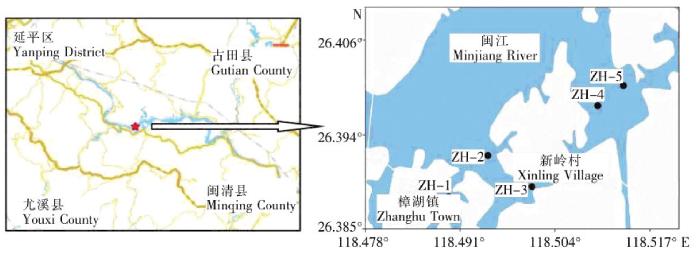
图1
樟湖库湾表层沉积物采样站位
Fig.1
Sampling stations of the surface sediments in Zhanghu reservoir bay
1.2 样品分析测定
目前AVS测定应用较多的是氮载气冷法酸溶硫化物分析法[13],因此样品实验室分析参考海洋沉积物硫化物测定方法[14],改进氮载气冷法酸溶硫化物分析技术碘量法测定沉积物中硫化物,具体为将反应瓶与吸收瓶串联,以氮气为载气并控制好流量,充分驱除尽氧气,称取3~5 g混匀的湿样并全量移入反应瓶中,在1.00 mol·L-1盐酸介质中充分反应并搅拌,生成的H2S随高纯氮气转移至内含0.05 mol·L-1乙酸锌溶液的吸收瓶中固定,之后使用碘量法测定AVS含量。在前述AVS反应中,将反应结束后的泥水混合物离心并以0.45 μm的醋酸纤维滤膜过滤,所得滤液采用电感耦合等离子体原子发射光谱仪(ICP-AES,Perkin Elmer Avio 200型)测定其中的Zn、Cr、Cu、Pb、Ni和Cd等6种SEM含量。AVS和SEM含量均用湿重表示,平行样品间的相对标准偏差控制在10%以内。
底栖动物样品经60目筛网过滤、清洗后,样品倒入白瓷盘中,挑拣出底栖动物,初步分类后放入玻璃瓶,用75%酒精固定保存。在实验室中,用解剖镜对底栖动物标本进行种类鉴定。
2 结果与分析
2.1 沉积物中AVS和SEM含量
樟湖库湾表层沉积物AVS、6种重金属(Zn、Cr、Cu、Pb、Ni和Cd)及SEM6(SEM6= SEMZn+ SEMCr+ SEMCu+ SEMPb+ SEMNi +SEMCd)含量见表1、表2,结果表明,AVS含量范围在0.57~2.13 μmol·g-1之间,梯度分布为ZH-1>ZH-4>ZH-5>ZH-2>ZH-3,网箱养殖区普遍高于非养殖区,采用2016年与2017年同个月份的监测结果进行比较,网箱养殖区平均AVS含量有所上升(图2)。SEM6含量范围在1.66~6.35 μmol·g-1之间,梯度分布为ZH-3>ZH-1>ZH-2>ZH-4>ZH-5(图3)。单个重金属的含量梯度为Zn>Cr>Cu>Pb>Ni>Cd,其中Zn的含量最高,浓度范围在1.05~3.06 μmol·g-1之间,贡献率占SEM6总量的比例介于45.11%~64.19%之间,平均比例超过50%(表2)。在年际间进行比较,各站位2017年SEM6含量较2016年均有不同程度上升(图3),表明重金属污染有可能出现积累,但重金属总量往往不能充分评价沉积物受污染程度,因为重金属的可迁移性和生物毒性还与其在沉积物中的不同存在形式密切相关。
表1 樟湖库湾表层沉积物AVS含量
Tab.1
| 年-月 Year-month | 站位Stations | ||||
|---|---|---|---|---|---|
| ZH-1 | ZH-2 | ZH-3 | ZH-4 | ZH-5 | |
| 2016-08 | 1.86 | 1.03 | 0.77 | 1.43 | 1.13 |
| 2016-11 | 1.40 | 0.83 | 0.63 | 1.11 | 1.12 |
| 2017-02 | 1.10 | 0.82 | 0.57 | 1.02 | 0.90 |
| 2017-05 | 1.58 | 1.31 | 0.68 | 1.55 | 1.38 |
| 2017-08 | 2.13 | 1.25 | 0.75 | 1.37 | 1.46 |
表2 樟湖库湾表层沉积物重金属及SEM6含量
Tab.2
| 项目 Items | 年-月 Year-month | 站位Stations | ||||
|---|---|---|---|---|---|---|
| ZH-1 | ZH-2 | ZH-3 | ZH-4 | ZH-5 | ||
| Zn | 2016-08 | 2.29 | 1.95 | 1.98 | 1.28 | 1.42 |
| 2016-11 | 2.98 | 2.29 | 2.72 | 1.28 | 1.05 | |
| 2017-02 | 2.34 | 2.15 | 2.60 | 1.12 | 1.20 | |
| 2017-05 | 3.06 | 2.88 | 2.32 | 1.51 | 1.11 | |
| 2017-08 | 2.80 | 2.83 | 2.98 | 2.58 | 1.52 | |
| 贡献率 | 49.80 | 46.74 | 45.11 | 61.77 | 64.19 | |
| Cr | 2016-08 | 1.02 | 1.15 | 0.92 | 0.33 | 0.29 |
| 2016-11 | 0.94 | 0.96 | 0.46 | 0.29 | 0.23 | |
| 2017-02 | 0.92 | 1.08 | 0.86 | 0.27 | 0.29 | |
| 2017-05 | 0.98 | 1.04 | 1.02 | 0.31 | 0.27 | |
| 2017-08 | 0.92 | 1.02 | 0.81 | 0.58 | 0.29 | |
| 贡献率 | 17.69 | 20.27 | 14.58 | 14.07 | 13.93 | |
| Cu | 2016-08 | 0.84 | 0.69 | 1.28 | 0.16 | 0.13 |
| 2016-11 | 0.78 | 0.70 | 0.75 | 0.17 | 0.13 | |
| 2017-02 | 0.88 | 0.73 | 1.86 | 0.15 | 0.16 | |
| 2017-05 | 0.91 | 0.86 | 1.11 | 0.19 | 0.12 | |
| 2017-08 | 1.00 | 0.86 | 1.58 | 0.52 | 0.13 | |
| 贡献率 | 16.28 | 14.84 | 23.52 | 9.38 | 6.93 | |
| Pb | 2016-08 | 0.46 | 0.46 | 0.58 | 0.29 | 0.31 |
| 2016-11 | 0.43 | 0.48 | 0.63 | 0.27 | 0.22 | |
| 2017-02 | 0.48 | 0.48 | 0.58 | 0.22 | 0.25 | |
| 2017-05 | 0.48 | 0.56 | 0.56 | 0.24 | 0.22 | |
| 2017-08 | 0.51 | 0.60 | 0.63 | 0.41 | 0.23 | |
| 贡献率 | 8.75 | 9.98 | 10.62 | 11.33 | 12.57 | |
| Ni | 2016-08 | 0.42 | 0.44 | 0.46 | 0.08 | 0.06 |
| 2016-11 | 0.39 | 0.39 | 0.19 | 0.07 | 0.03 | |
| 2017-02 | 0.41 | 0.42 | 0.32 | 0.03 | 0.05 | |
| 2017-05 | 0.39 | 0.42 | 0.37 | 0.06 | 0.05 | |
| 2017-08 | 0.39 | 0.41 | 0.34 | 0.19 | 0.03 | |
| 贡献率 | 7.39 | 8.05 | 6.00 | 3.37 | 2.33 | |
| Cd | 2016-08 | 0.005 | 0.007 | 0.010 | 0.001 | 0.001 |
| 2016-11 | 0.004 | 0.008 | 0.009 | 0.001 | 0.001 | |
| 2017-02 | 0.004 | 0.005 | 0.012 | 0.001 | 0.001 | |
| 2017-05 | 0.005 | 0.008 | 0.008 | 0.001 | 0.001 | |
| 2017-08 | 0.004 | 0.006 | 0.010 | 0.006 | 0.001 | |
| 贡献率 | 0.08 | 0.13 | 0.17 | 0.08 | 0.05 | |
| SEM6 | 2016-08 | 5.04 | 4.70 | 5.24 | 2.13 | 2.21 |
| 2016-11 | 5.54 | 4.84 | 4.76 | 2.07 | 1.66 | |
| 2017-02 | 5.03 | 4.88 | 6.24 | 1.79 | 1.95 | |
| 2017-05 | 5.83 | 5.76 | 5.39 | 2.30 | 1.77 | |
| 2017-08 | 5.62 | 5.73 | 6.35 | 4.28 | 2.21 | |
图2
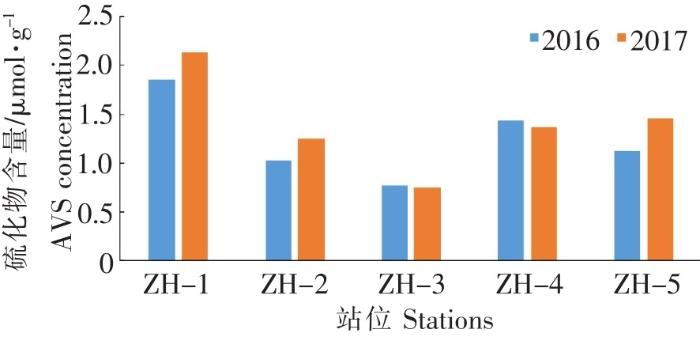
图2
樟湖库湾表层沉积物AVS含量的年际变化
Fig.2
Year variation of AVS concentration in surface sediments of Zhanghu reservoir bay
图3
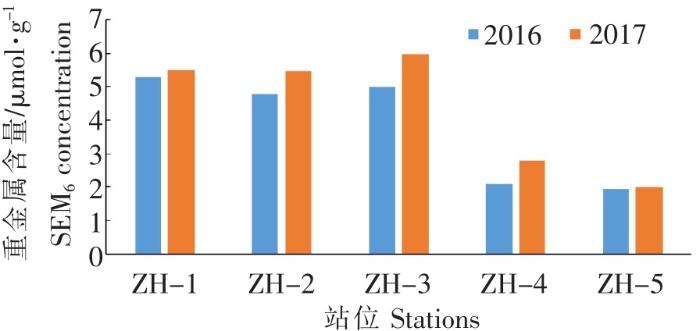
图3
樟湖库湾表层沉积物SEM6含量的年际变化
Fig.3
Year variation of SEM6 concentration in surface sediments of Zhanghu reservoir bay
2.2 沉积物SEM/AVS及重金属生物有效性
目前,已有诸多国家和地区应用AVS与SEM之间的关系来评价水生生态系统沉积物质量,因此本研究采用SEM/AVS比值及差值法结合理论预测作为评估表层沉积物重金属生态风险的依据。结果表明(表3,图4),樟湖库湾各站位SEM6/AVS值为1.28~10.95,年平均值在1.65~9.11之间;从空间分布看,ZH-1、ZH-2、ZH-3站位SEM6/AVS普遍高于ZH-4、ZH-5,这种分布特征的差异与陆源输入对重金属污染的影响基本一致。与生物毒性效应阈值(表4)[15⇓-17]比较,Pb污染比较严重,全部站位均超出低限效应值,站位ZH-3部分调查频次甚至超出上限效应值;其他5种重金属则区域差异很明显:ZH-1、ZH-2和ZH-3站位基本介于低限效应值和上限效应值之间,ZH-4和ZH-5站位均低于低限效应值(表3)。从年平均值来看(图4),ZH-3站位在2017年时(SEM6-AVS)> 5(但两年的平均值小于5),其他站位(SEM6-AVS)值均介于0~5之间。2017年与2016年相比较,各站位SEM/AVS与(SEM-AVS)均有不同程度上升,表明重金属产生的生物有效性可能在上升。
表3 樟湖库湾表层沉积物SEM/AVS比值和(SEM-AVS)差值
Tab.3
| 项目 Items | 年-月 Year-month | 站位Stations | ||||
|---|---|---|---|---|---|---|
| ZH-1 | ZH-2 | ZH-3 | ZH-4 | ZH-5 | ||
| SEM6/AVS | 2016-08 | 2.71 | 4.56 | 6.81 | 1.49 | 1.96 |
| 2016-11 | 3.96 | 5.83 | 7.56 | 1.86 | 1.48 | |
| 2017-02 | 4.57 | 5.95 | 10.95 | 1.75 | 2.17 | |
| 2017-05 | 3.69 | 4.40 | 7.93 | 1.48 | 1.28 | |
| 2017-08 | 2.64 | 4.58 | 8.47 | 3.12 | 1.51 | |
| SEM6-AVS /μmol·g-1 | 2016-08 | 3.18 | 3.67 | 4.47 | 0.70 | 1.08 |
| 2016-11 | 4.14 | 4.01 | 4.13 | 0.96 | 0.54 | |
| 2017-02 | 3.93 | 4.06 | 5.67 | 0.77 | 1.05 | |
| 2017-05 | 4.25 | 4.45 | 4.71 | 0.75 | 0.39 | |
| 2017-08 | 3.49 | 4.48 | 5.60 | 2.91 | 0.75 | |
| SEM5/AVS | 2016-08 | 2.16 | 3.45 | 5.61 | 1.26 | 1.70 |
| 2016-11 | 3.29 | 4.67 | 6.83 | 1.60 | 1.28 | |
| 2017-02 | 3.74 | 4.63 | 9.44 | 1.49 | 1.84 | |
| 2017-05 | 3.07 | 3.60 | 6.43 | 1.28 | 1.09 | |
| 2017-08 | 2.21 | 3.77 | 7.39 | 2.70 | 1.32 | |
| SEM5 - AVS /μmol·g-1 | 2016-08 | 2.16 | 2.52 | 3.55 | 0.37 | 0.79 |
| 2016-11 | 3.20 | 3.05 | 3.67 | 0.67 | 0.31 | |
| 2017-02 | 3.01 | 2.98 | 4.81 | 0.50 | 0.76 | |
| 2017-05 | 3.27 | 3.41 | 3.69 | 0.44 | 0.12 | |
| 2017-08 | 2.57 | 3.46 | 4.79 | 2.33 | 0.46 | |
表4 水体沉积物中金属元素对底栖生物产生毒性效应的阈值[15-16]
Tab.4
| 阈值 Threshold | 元素Metals | |||||
|---|---|---|---|---|---|---|
| Cd | Cu | Pb | Ni | Zn | Cr* | |
| 低限效应值 Lower limit effects level | 0.005 3 | 0.561 8 | 0.168 9 | 0.306 6 | 1.882 8 | 0.486 |
| 上限效应值 Upper limit effects threshold | 0.026 69 | 1.353 4 | 0.612 9 | 0.732 5 | 7.953 5 | 1.826 |
注:Cr*引自海洋沉积物中重金属对底栖生物产生毒性效应的阈值[
Note:Cr* uses the data from toxicity thresholds of heavy metal in marine sediments to benthic organisms.
图4
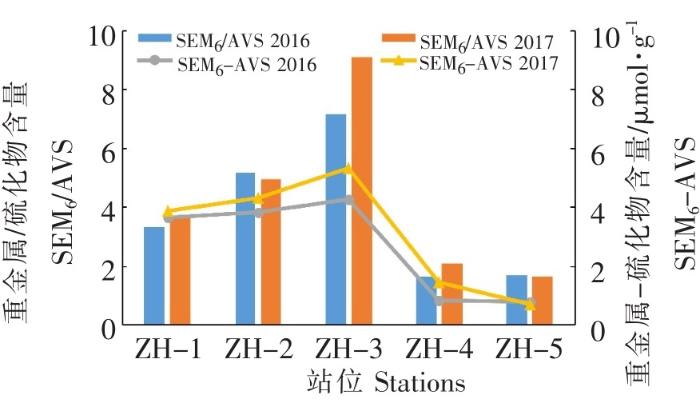
图4
樟湖库湾表层沉积物SEM6/AVS和(SEM6-AVS)
Fig.4
SEM6 /AVS and(SEM6-AVS)in surface sediments of Zhanghu reservoir bay
图5
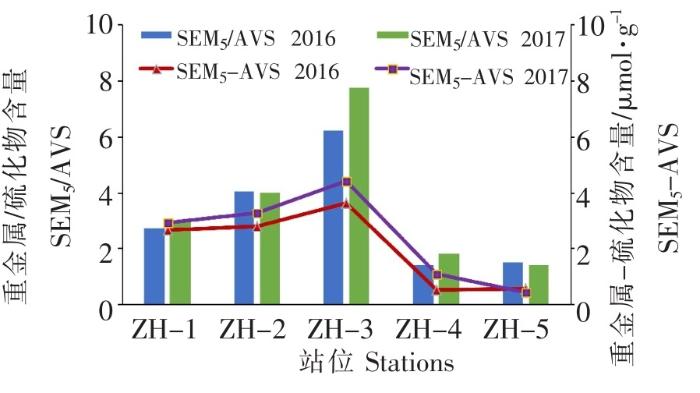
图5
樟湖库湾表层沉积物SEM5 /AVS和(SEM5-AVS)
Fig.5
SEM5 /AVS and(SEM5-AVS)in surface sediments of Zhanghu reservoir bay
2.3 樟湖库湾底栖动物
SEM/AVS方法可用于预测重金属的生物有效性及建立沉积物的重金属质量标准,而研究沉积物重金属质量标准主要是保护底栖生物不受其生存的沉积物因重金属污染而造成的直接毒性危害。通过对樟湖库湾底栖动物定性调查发现(表5),樟湖库湾ZH-1、ZH-2和ZH-3站位鉴定出水丝蚓(Limnodrilus)、颤蚓(Tubifex)和铜锈环棱螺(Bellamya aeruginosa)等3个底栖动物属种,ZH-4和ZH-5站位只鉴定出水丝蚓等1个属种,大型底栖动物种类和数量均较少,可能是因为樟湖库湾水位较深(>10 m),底层低氧、低温和低生产力等环境特征限制了大型底栖生物的生存;ZH-4和ZH-5站位水深约20 m,底栖动物组成更为单调。
表5 樟湖库湾底栖生物种类与分布
Tab.5
| 底栖生物 Bentonic organism | 站位Stations | |||||
|---|---|---|---|---|---|---|
| ZH-1 | ZH-2 | ZH-3 | ZH-4 | ZH-5 | ||
| 环节动物门Annelida | 水丝蚓Limnodrilus | + | + | + | + | + |
| 颤蚓Tubifex | + | — | + | — | — | |
| 软体动物门Mollusca | 铜锈环棱螺 Bellamya aeruginosa | + | + | + | — | — |
注:“+”表示检出,“—”表示未检出。
Note:“+”indicated detected,“—”indicated not detected.
3 讨论
3.1 AVS和SEM分布特征分析
沉积物中由AVS控制生物有效性的重金属一般是溶度积小于FeS的Ni、Zn、Cd、Pb、Cu以及Cr等[15]。研究区域内AVS含量范围与邻近樟湖库湾的闽江流域尤溪、闽江干流等站位的监测结果(0.35~1.90 μmol·g-1)[18]较为接近;梯度分布特征则表明网箱养殖活动对底质AVS的积累具有一定的影响,可能是因为随着养殖年限增加,网箱养殖区有机质含量升高,形成较强的还原环境,有利于硫化物的产生和累积。从SEM6含量的梯度分布可以看出,ZH-1、ZH-2和ZH-3站位的重金属含量均明显高于ZH-4、ZH-5站位,可能是因为前3个站位所处水域邻近樟湖镇生活区,生活污水及城镇径流的排入增加了重金属来源,同时较浅的水深也有利于重金属的沉降积累;而ZH-4、ZH-5站位远离樟湖镇,周边人类活动较少,重金属污染程度较低,SEM的空间分布特征表明重金属的积累主要受陆源输入污染的影响。有文献[19]也指出,闽江流域表层沉积物重金属污染主要来自于城市建设、交通、生活以及工业污染物的输入和河流的交汇。
3.2 沉积物重金属生物有效性分析
各站位SEM6/AVS均大于1,表明沉积物中重金属只有一部分与S2-结合形成难溶硫化物,还有部分重金属可能以游离态的形式存在,其生物有效性高,可能存在潜在的生物毒性。不过,重金属的生物毒性还与其所处的沉积环境(如铁锰氧化物、有机质等其他组成成分)以及底栖生物的种类、活动习性等诸多因素有关。为更深入地评价沉积物中重金属潜在生态风险,本研究对SEM单个重金属与相应可产生生物毒性效应的阈值进行了比较,一般认为重金属含量低于低限效应值几乎不会对生物产生毒性效应,高于上限效应值会经常产生毒性,介于两者之间则会偶然产生毒性效应[22-23],由此推断Pb可能产生的生物有效性最高,存在对底栖生物产生毒性效应的潜在可能性。
以SEM/AVS比值法预测沉积物重金属的生物有效性,在SEM/AVS<1时,预测结果是肯定的,但是当SEM/AVS>1时,预测结果可能过高估计了重金属的生物有效性[7,24]。有研究表明,在SEM/AVS>1时,并不是所有的的沉积物都能引起生物毒性,因为沉积物中还存在许多其他形式重金属的结合态(如有机物结合态)等[24],重金属生物有效性还会受其他因素影响。因此在本研究区域6种重金属SEM6/AVS>1的情况下,进一步结合美国环保署(EPA)的(SEM-AVS)差值比较法[25]进行评价,即差值(SEM-AVS)>5为第一类,重金属对水生生物可能有高毒性;0<(SEM-AVS)<5为第二类,重金属对水生生物可能有中等毒性;(SEM-AVS)< 0为第三类,重金属对水生生物无不良影响,从年平均值来看,(SEM6-AVS)基本在0~5之间,据此推断总体上重金属对水生生物处于中等毒性水平。
有研究表明Cr在水中主要存在形态为
值得注意的是,从各站位SEM/AVS值可以看出,站位ZH-3由于AVS含量较低导致SEM6/AVS明显高于其他站位。ZH-1和ZH-2站位SEM6含量也不低,但是由于AVS含量较高,相当一部分重金属可以由AVS固定,因此其对水生生物的危害反而没有ZH-3站位高;虽然网箱养殖区受到的重金属潜在生态危害会由于AVS含量升高而下降,但是AVS在沉积物中往往处于动态变化之中,生物扰动、再悬浮等都会降低其浓度,从而增加沉积物重金属的生物有效性,硫化物中重金属再次释放造成二次污染的潜在性危害也更大。此外,网箱养殖区AVS在沉积物含量的逐年递增,随着养殖环境向还原性环境转变,更有利于硫酸盐还原菌(SRB)将硫酸盐转化为H2S[28],H2S水溶性强,也易于从沉积物向水体扩散,而美国环保署的Epiweb41软件计算研究表明H2S的毒性远比本研究中的任何一种重金属强,同时生成的H2S还通过向水体传递电子而使其缺氧,从而导致养殖生物缺氧[29],因而网箱养殖区受到H2S的潜在危害更为严重,也更需警惕。因此,水库网箱养殖要注意控制规模、合理布局、提高饵料利用率及放养滤食性鱼类等,以降低养殖活动对沉积环境硫化物的影响,此外樟湖库湾重金属的生态风险现状应引起足够的关注和重视。
3.3 底栖动物分析
4 结论
1)樟湖库湾表层沉积物AVS含量范围在0.57~2.13 μmol·g-1之间,梯度分布为ZH-1>ZH-4>ZH -5>ZH-2>ZH-3,网箱养殖活动对底质AVS的积累具有一定的影响。SEM6含量范围在1.66~6.35 μmol·g-1之间,梯度分布为ZH-3>ZH-1>ZH-2>ZH-4>ZH-5,ZH-1、ZH-2、ZH-3站位所在区域邻近樟湖镇生活区且水深较浅,ZH-4、ZH-5站位所在区域周边人类活动较少,SEM的空间分布特征表明重金属的积累主要受陆源输入污染的影响。SEM梯度表现为Zn>Cr>Cu>Pb>Ni>Cd,分布模式主要由Zn控制(贡献率超过50%),Zn、Cr、Cu是主要污染重金属。年际间比较表明,各站位2017年SEM6含量较2016年均有不同程度的上升,重金属污染有可能出现积累。
2)AVS与重金属生物有效性评价:樟湖库湾各站位SEM6/AVS值为1.28~10.95,年平均值在1.65~9.11之间,均大于1,沉积物重金属可能存在潜在的生物毒性。单个重金属与其生物毒性效应阈值比较,Pb可能产生的生物毒性最高。(SEM-AVS)差值法结果表明,ZH-3站位2017年(SEM6-AVS)>5(两年的平均值小于5),具有较高的重金属生态毒理风险,其他站位差值介于0~5之间,总体上看沉积物中重金属对水生生物处于中等毒性水平。Cr不列入计算则研究区域内(SEM5-AVS)均处于0~5之间,基本未出现SEM5/AVS>8的站位,表明AVS对重金属的束缚有重要影响,大部分表层沉积物的重金属尚不会对底栖生物产生明显毒性,但两年的比较结果显示各站位SEM5/AVS均有所上升,樟湖库湾重金属生态风险现状应引起重视。
3)虽然网箱养殖区受到的重金属潜在生态危害会由于AVS含量升高而下降,但是硫化物中重金属再次释放造成二次污染的潜在性危害也更大。而且随着还原性环境的转变,受到H2S的潜在危害更为严重,H2S的毒性远比本研究中的任何一种重金属强,还容易导致养殖生物缺氧,其潜在危害更需警惕。水库网箱养殖要注意控制规模、合理布局、提高饵料利用率及放养滤食性鱼类等,以降低养殖活动对沉积环境硫化物的影响。
参考文献
Bioturbation and the oxidation of sulfide in sediments
[J].
Relationship between acid volatile sulfide and the toxicity of zinc, lead and copper in marine sediments
[J].
Reactive sulfides relationship with metals in sediments from an eutrophicated estuary in Southeast Brazil
[J].
The potential association of acid-volatile sulfides (AVS) and reactive (HCl soluble) Fe with the distribution of reactive trace metals (Cu, Cd, Ni, Pb and Zn) was investigated in sediment cores collected in the Iguaçu river estuarine system (Guanabara bay, Brazil), within the river (core R) and the bay (core B) areas. Moderate to extremely high AVS concentrations (33-314 micromol g(-1)) were found in the rapidly-accumulated sediments of this eutrophicated estuary. AVS showed significant correlations with Fe, Ni and Pb in core B, whereas no correlation between AVS and metals was observed in core R. Results suggest that the AVS:Fe molar ratio may often reflect the diagenetic conditions controlling the distribution of Cd and Cu in core B better than AVS and Fe levels themselves. A shift in the biogeochemical controls of metal distribution from the river to the open bay sediments is suggested, with a greater association of most metals with AVS and Fe in bay sediments.
Geochemical cycling and speciation of copper in waters and sediments of Macquarie Harbour, Western Tasmania
[J].
Analysis of acid-volatile sulfide(AVS)and simultaneously extracted metals(SEM)for the estimation of potential toxicity in aquatic sediments
[J].
樟湖库湾网箱养殖区沉积物氮的时空变化特征
[J].为研究网箱养殖区表层沉积物中氮的时空变化特征,于 2016年6月—2017年5月在樟湖库湾选取不同网箱养殖区采集沉积物,按月测定和分析总氮、铵态氮、硝态氮含量,并探讨不同网箱养殖区沉积物中各形态氮之间的相关关系。结果表明,网箱养殖区沉积物中总氮、铵态氮、硝态氮含量年变化范围分别为530.00~3570.00、28.29~362.46、3.36~7.98 mg/kg,总氮和铵态氮呈现明显的季节变化,总氮含量总体趋势为冬季高夏季低,铵态氮含量为夏季最高,而硝态氮季节变化差异不大;不同网箱养殖区域沉积物中氮含量存在空间差异显著性,高密度网箱养殖区沉积物中总氮和铵态氮平均含量显著高于对照点,低密度网箱养殖区总氮平均含量显著低于对照点,但铵态氮和硝态氮含量与对照点无显著差异。各形态氮之间的相关性在不同养殖区域沉积物中也不尽相同,网箱养殖区沉积物中铵态氮含量分别与总氮、硝态氮呈现显著相关性(P<0.05)。
The utility of pore-water toxicity testing for development of site-specific marine sediment quality objectives for metals
[EB/OL]. (
Seasonal bioavailability of sediment-associated heavy metals along the Mississippi river floodplain
[J].A value of simultaneously extracted metal to acid-volatile sulfide (SEM-AVS) can provide important information regarding metal availability in anaerobic sediment. SEM and AVS concentrations were obtained by the cold-acid purge-and-trap technique during spring and summer at six locations along the Mississippi River floodplain. SEM-AVS values and AVS concentrations did not vary significantly between locations during both seasons. AVS concentrations were significantly greater during summer than spring, resulting in significantly lower SEM-AVS values in summer. Total SEM concentrations did not significantly vary between seasons or specific locations. SEM-AVS values were greater than one at each location during both seasons. Sediment metal toxicity was predicted to be absent for benthic organisms along the river floodplain.
Predicting sediment metal toxicity using a sediment biotic ligand model:methodology and initial application
[J].An extension of the simultaneously extracted metals/acid‐volatile sulfide (SEM/AVS) procedure is presented that predicts the acute and chronic sediment metals effects concentrations. A biotic ligand model (BLM) and a pore water—sediment partitioning model are used to predict the sediment concentration that is in equilibrium with the biotic ligand effects concentration. This initial application considers only partitioning to sediment particulate organic carbon. This procedure bypasses the need to compute the details of the pore‐water chemistry. Remarkably, the median lethal concentration on a sediment organic carbon (OC)—normalized basis,SEM*x,OC, is essentially unchanged over a wide range of concentrations of pore‐water hardness, salinity, dissolved organic carbon, and any other complexing or competing ligands. Only the pore‐water pH is important. Both acute and chronic exposures in fresh‐ and saltwater sediments are compared to predictions for cadmium (Cd), copper (Cu), nickel (Ni), lead (Pb), and zinc (Zn) based on theDaphnia magnaBLM. TheSEM*x,OCconcentrations are similar for all the metals except cadmium. For pH = 8, the approximate values (μmol/gOC) are Cd‐SEM*x,OC⋍ 100, Cu‐SEM*x,OC⋍ 900, Ni‐SEM*x,OC⋍ 1,100, Zn‐SEM*x,OC⋍ 1,400, and Pb‐SEM*x,OC⋍ 2,700. This similarity is the explanation for an empirically observed dose—response relationship between SEM and acute and chronic effects concentrations that had been observed previously. This initial application clearly demonstrates that BLMs can be used to predict toxic sediment concentrations without modeling the pore‐water chemistry.
Sediment quality in Burlington Harbor,Lake Champlain,USA
[J].
闽江流域表层沉积物硫化物及重金属生物毒性研究
[J].根据2012—2013年福建省闽江流域富屯溪、建溪和沙溪等支流以及干流7个站位表层沉积物调查数据,对硫化物(AVS)、有机碳及重金属(SEM)等物质进行了研究。结果表明,各站位硫化物两年平均含量在0.4610 ~ 1.8140 μmol?g-1之间,有机碳平均含量在0.76 % ~ 1.51 %之间,尤溪S5站位硫化物明显高于其他站位,与此对应有机碳含量也较高,这与沿岸人类活动的强度有关;闽江干流S7站位硫化物含量最低,主要受水动力特征影响。各站位沉积物重金属(Cu,Pb,Cd,Hg和As)含量基本呈现Cu>Pb>As>Hg>Cd的趋势,其中Cu和Pb是主要污染重金属。SEM平均含量在0.47 ~ 3.58 μmol?g-1之间,金溪S2、古田溪S6站位SEM/AVS(摩尔比值)小于1,重金属潜在生态危害风险较小;其他站位SEM/AVS大于1,生物有效性高,具有潜在的毒性效应。与水体沉积物中金属元素对底栖生物产生毒性效应的阈值比较,单个重金属中Pb和Cd可能产生的生物有效性高于Cu,具有对底栖生物产生毒性效应的潜力。
Predicting the acute toxicity of copper in freshwater sediments:evaluation of acid-volatile sulfide
[J].
Acid volatile sulfide and simultaneously extracted metals in the sediment cores of the Pearl River Estuary, South China
[J].The acid-volatile sulfide (AVS), simultaneously extracted metals (SEM), total metals, and chemical partitioning in the sediment cores of the Pearl River Estuary (PRE) were studied. The concentrations of total metals, AVS, and SEM in the sediment cores were generally low in the river outlet area, increased along the seaward direction, and decreased again at the seaward boundary of the estuary. The amounts of AVS were generally greater in deeper sediments than in surface sediments. SEM/AVS was >1 in the surface sediments and in the river outlet cores. The ratio was <1 in the sediments down the profiles, suggesting that AVS might play a major role in binding heavy metals in the deep sediments of the PRE. The SEM may contain different chemical forms of trace metals in the sediments, depending on the metal reaction with 1M cold HCl in the AVS procedure compared with the results of the sequential chemical extraction. The SEM/AVS ratio prediction may overestimate trace metal availability even in the sediments with high AVS concentrations.
Chemical influences on trace metal-sulfide interactions in anoxic sediments
[J].
Characterizing sediment acid volatile sulfide concentrations in European streams
[J].Sediment acid volatile sulfide (AVS) concentrations were measured in wadeable streams of a wide variety of ecoregions of western Europe (84 sites in 10 countries and nine ecoregions) to better understand spatial distribution and ecoregion relationships. Acid volatile sulfide has been shown to be a major factor controlling the bioavailability and toxicity of many common trace metals, such as Cd, Cu, Ni, Pb, and Zn. Sediment characteristics varied widely. The ratio of the sum of the simultaneously extracted metals (SEM) to AVS ranged from 0.03 to 486.59. The sigmaSEM-AVS ranged from -40.02 to 17.71 micromol/g. On a regional scale, sediment characteristics such as dominant parent soil material showed significant trends in AVS distribution and variation by ecoregion. Total Fe and Mn were correlated weakly with SEM concentrations. Three AVS model approaches (i.e., the SEM:AVS ratio, SEM-AVS difference, and carbon normalization) were compared at threshold exceedance levels of SEM/AVS > 9, SEM-AVS > 2, and SEM-AVS/foc > 150 micromol/g organic carbon (OC). Only 4.76% of the sediments exceeded all three AVS thresholds; 22.6% of the sediments exceeded two models; and 13% of the sediments exceeded one model only. Using the SEM:AVS, SEM-AVS, and fraction of organic carbon models, and including site-specific data and regional soil characteristics, ecoregions 1 (Portugal), 3 (Italy), 4 (Switzerland), and 9 (Belgium/Germany) had the highest potential metals toxicity; ecoregions 13 and 8 (Belgium/France) showed the lowest potential toxicity. However, because AVS can vary widely spatially and temporally, these data should not be considered as representative of the sampled ecoregions. The general relationship between AVS levels and sediment characteristics provides some predictive capability for wadeable streams in the European ecoregions.
Geomicrobiology:sediment reactions defy dogma
[J].
Electric currents couple spatially separated biogeochemical processes in marine sediment
[J].
 图1
图1 表1
表1


