



镉(Cadmium,Cd)是一种非生物所需的重金属元素,毒性高,生物半衰期长[1]。镉在环境中广泛存在,可以通过食物链传递富集于生物体[2-3]。人若长期食用镉污染食物,则其机体会过量蓄积镉而使多系统、多脏器受到损害[4⇓-6]。国内外多项调研结果表明,水产品中镉污染现象较为普遍,特别是在贝类、甲壳类和头足类的镉含量高[7⇓⇓⇓⇓-12]。近年来国内外多位学者对市场贩售和不同水域范围内的水产品以点评估方式开展镉食用健康风险评估[13⇓⇓⇓⇓⇓-19],结果也认为蟹类镉污染较为普遍,建议减少蟹类的消费[13-14];有些品种的贝类[15,17]、小龙虾头部及幼虾[16]有一定的镉食用健康风险。镉污染已经成为影响水产品质量安全的重要因素之一。由于点评估法无法量化水产品中镉含量的变异,因此有必要采用更为准确的概率评估法,分析水产品中镉污染的主要来源以及影响风险值的主要品种,从而找出控制镉食用健康风险的有效措施。为避免因消费水产品的品种、数量及镉在同类水产品中含量变异过大,而导致评估结果产生偏差,本研究以居民消费习惯相近的福建南部沿海地区(泉州、厦门、漳州)为评估对象,根据2017—2022年福建南部沿海6类大宗消费水产品,包括鱼类、虾类、蟹类、贝类、头足类和藻类等共1 004个样品的检测结果,结合2015年厦门市居民各类水产品膳食结构调查数据进行概率评估[20],旨在客观地反映水产品中镉食用风险状况及其主要来源,为行业主管部门控制镉摄入健康风险提供技术参考。
1 材料与方法
1.1 样品采集
样品为2017—2022年在福建省南部泉州、厦门、漳州沿海开展风险监测所采集的样品,共1 004个;主要来源于养殖和捕捞环节的鱼类、虾类、蟹类、贝类、头足类和藻类等。养殖环节的样品在沿海养殖场采集;捕捞环节的样品在渔获码头和水产批发市场采集;淡水蟹在福建沿海养殖规模小,因此其主要在批发市场采集。鱼类样品(128个)均为海水鱼,其中养殖鱼类包括美国红鱼(Sciaenops ocellatus)、真鲷(Pagrus major)、鲈(Lateolabrax japonicus)、黄鳍鲷(Acanthopagrus latus)、黑鲷(Acanthopagrus schlegelii)、斜带髭鲷(Hapalogenys nitens);捕捞鱼类包括带鱼(Trichiuridae)、鲅(Scomberomorus niphonius)、鲳(Pampus)、红棘金线鱼(Nemipteridae)、马面鲀(Thamnaconus)、鲻鱼(Mugilcephalus linnaeus)、鲐(Scomber japonicus)等。在虾类样品(178个)中,养殖虾类包括南美白对虾(Penaeus vannamei)、南非斑节虾(Penaeus monodon)、日本对虾(Penaeus japonicus);捕捞虾类包括鹰爪虾(Trachypenaeus curvirostris)、刀额新对虾(Metapenaeus ensis)等。在蟹类样品(355个)中,养殖蟹类为海水锯缘青蟹(Scylla serrata)和淡水中华绒螯蟹(Eriocheir sinensis);捕捞蟹类为海水品种,包括三疣梭子蟹(Portunus trituberculatus)、远海梭子蟹(Portunus pelagicus)、红星梭子蟹(Portunus sanguinolentus)、拥剑梭子蟹(Portunus gladiator)等。贝类样品(184个)为福建南部沿海主要养殖品种,包括太平洋牡蛎(Crassostrea gigas)、僧帽牡蛎(Ostrea cucullata)、近江牡蛎(Crassostrea rivularis)、波纹巴菲蛤(Paphia undulata)、菲律宾蛤仔(Ruditapes philippinarum)。头足类样品(88个)均来源于捕捞,包括火枪乌贼(Loligo beka)、中国枪乌贼(Loligo chinensis)、杜氏枪乌贼(Loligo duvaucelii)、金乌贼(Sepia esculenta)、曼氏无针乌贼(Sepiella maindroni)、章鱼(Octopus)。藻类样品(71个)为沿海养殖的海带(Thallus laminariae)和紫菜(Porphyra haitanensis)。
1.2 镉含量测定
依据GB 5009.15—2014《食品安全国家标准 食品中镉的测定》方法检测水产品中总镉含量。采用Mars6微波消解仪(美国CEM公司)消解试样,ICE3500原子吸收分光光度计(美国Thermo SCIENTIFIC)测定,方法检测限为0.001 mg·kg-1。
1.3 相关数据来源
1.3.1 人体体重数据
表1 不同年龄组人群平均体重
Tab.1
| 年龄组Age groups | 年龄Age | 体重/kg Body weight |
|---|---|---|
| 少年Juvenile | 7~17 | 43.3 |
| 青年Youth | 18~40 | 61.6 |
| 中年Middle age | 41~65 | 64.8 |
| 老年Old age | ≥66 | 59.1 |
1.3.2 水产品摄入量数据
表2 不同年龄组人群每人日均水产品摄入量
Tab.2
| 种类 Species | 少年(≤18岁) Juvenile | 青年(19~40岁) Youth | 中年(41~60岁) Middle age | 老年(>60岁) Old age | 平均 Average |
|---|---|---|---|---|---|
| 鱼类Fish | 12.83 | 35.89 | 29.14 | 14.32 | 29.92 |
| 虾类Shrimp | 13.49 | 9.78 | 4.54 | 3.65 | 7.94 |
| 蟹类Crab | 5.84 | 6.08 | 3.50 | 4.00 | 5.31 |
| 贝类Shellfish | 21.27 | 20.37 | 15.88 | 12.01 | 18.06 |
| 头足类Cephalopods | 4.14 | 5.95 | 3.58 | 1.94 | 4.77 |
| 藻类Algae | 6.97 | 9.70 | 10.14 | 5.36 | 8.78 |
1.4 风险评估方法
水产品中镉的食用健康风险评估是通过对人体每日镉实际摄入量与镉每日允许摄入量的比较,评价指标为暴露边界值(Margin of exposure,MOE)[22],按公式(1)进行计算。
概率风险评估采用水晶球软件(Oracle Crystal Ball 11.1.2.4.850),首先对镉在各类水产品中的分布进行概率拟合(低于检测限的数据采用1/2检测限参与拟合计算)。分别以A-D检验(Anderson-darling检验)、K-S检验(Kolmogorov-smirnov检验)和
2 结果与分析
2.1 不同种类水产品中镉的含量
本研究样品采集时间为2017—2022年,不同年度采集样品均在当年完成检测,结果见表3。以大虾成分分析标准物质[(0.039±0.002)mg·kg-1,地球物理地球化学勘查研究所];紫菜成分分析标准物质[(0.49±0.03)mg·kg-1,钢研纳克检测技术股份有限公司];扇贝成分分析标准物质[(1.06±0.1 mg·kg-1),地球物理地球化学勘查研究所]为质控样。开展检测时,质控样与样品同时进行,结果误差均在保证值允许范围内。
表3 不同种类水产品镉含量
Tab.3
| 种类 Species | 样品数/个 Number | 含量范围/ mg·kg-1 Content range | 平均值/mg·kg-1 Average | 标准偏差/mg·kg-1 Standard deviation | 超标率/% Exceeding standard rate |
|---|---|---|---|---|---|
| 鱼类Fish | 128 | ND~0.070 0 | 0.0076 0 | 0.012 8 | 0 |
| 虾类Shrimp | 178 | ND~0.066 0 | 0.017 4 | 0.017 8 | 0 |
| 蟹类Crab | 355 | 0.011 0~1.86 | 0.334 | 0.346 | 25.6 |
| 贝类Shellfish | 184 | 0.085 0~1.02 | 0.195 | 0.231 | 0 |
| 头足类Cephalopods | 88 | 0.013 0~0.760 | 0.299 | 0.164 | 0 |
| 藻类Algae | 71 | 0.001 40~0.120 | 0.049 6 | 0.032 2 | / |
注:ND为未检出。
Note:ND meant not detected.
根据GB 2762—2017《食品安全国家标准 食品中污染物限量》,鱼类、甲壳类和双壳类、头足类(去除内脏)限量标准分别为0.1、0.5和2.0 mg·kg-1,藻类未设定限量标准。所监测的鱼类、虾类、贝类、头足类样品均合格。蟹类超标率为25.6%,超标样中海水蟹和淡水蟹占比分别为97.6%和2.43%。可见,当前水产品镉超标品种主要为海水蟹,这些超标海水蟹大多来源于捕捞环节,涉及本研究采集的所有4种海捕蟹。这些海水蟹的捕获地点分散,未表现出明显的区域特点。同时超标的海水蟹镉含量范围在0.52 ~1.86 mg·kg-1之间,最高值未超过头足类2.0 mg·kg-1限量标准。因此,推断海水蟹超标的原因是自身具备富集镉的生理特点,并非环境或食物污染所致。当前国内对蟹类中镉限量标准为“甲壳类0.5 mg·kg-1”,甲壳类水产品主要为各种虾类和蟹类,不同种类甲壳类水产品镉含量差异大。海水蟹中镉含量比对虾要高1个数量级以上,如果都采用0.5 mg·kg-1限量标准,将导致海水蟹超标率升高。根据表2膳食调查结果,沿海居民蟹类摄入量与头足类相近,如果以头足类2.0 mg·kg-1限量标准判定蟹类,本次采集的355个蟹类样品则全部合格。因此,建议对不同种类的甲壳类水产品的评价,应根据实际情况对镉限量标准作更细的区分和说明。
2.2 居民膳食水产品摄入镉风险评估
2.2.1 居民膳食水产品摄入镉风险概率分布
应用水晶球软件概率分布拟合功能,采用A-D检验、K-S检验和
表4 各类水产品中镉分布拟合参数
Tab.4
| 种类 Species | 最佳拟合分布 Best-fit distribution | 参数 Parameter | ||
|---|---|---|---|---|
| 鱼类Fish | 对数正态 | 位置=0.00 | 平均值=0.007 82 | 标准偏差=0.024 6 |
| 虾类Shrimp | 对数正态 | 位置=0.00 | 平均值=0.020 4 | 标准偏差=0.042 2 |
| 蟹类Crab | 对数正态 | 位置=0.004 45 | 平均值=0.351 | 标准偏差=0.511 |
| 贝类Shellfish | 对数正态 | 位置=0.007 58 | 标度=0.240 | 形状=0.689 |
| 头足类Cephalopods | 逻辑 | 平均值=0.299 | 标度=0.094 3 | — |
| 藻类Algae | Beta | 最小值=-0.001 12 最大值=0.114 | Alpha=0.963 | Beta=1.22 |
采用水晶球软件计算居民摄食水产品中镉风险概率分布,结果见图1。MOE值分布曲线的P50、P90和P97.5分别为0.093 1、0.246和0.505,表明平均居民摄入水产品中镉MOE值低于0.093 1;绝大部分居民摄入水产品中镉MOE值低于0.246;高暴露人群摄入水产品中镉MOE值低于0.505,这3个百分位数MOE值均远小于限量值1,说明福建南部沿海居民由水产品摄入镉的食用健康风险程度总体上在可接受范围内。
图1
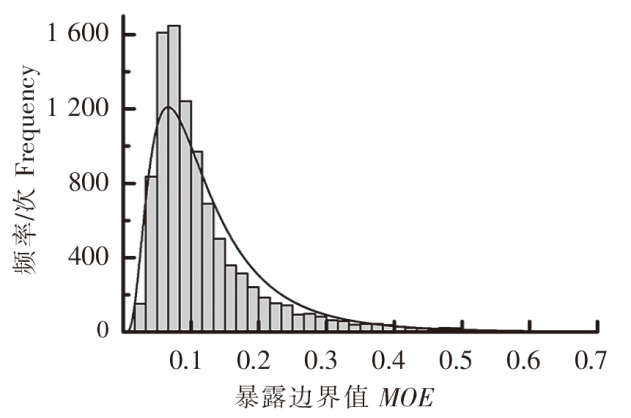
图1
沿海居民水产品中镉健康风险概率分布
Fig.1
Probability distribution of health risk of cadmium intake in the aquatic products by coastal resident
2.2.2 不同年龄段镉健康风险评估
由于各年龄段的体重、摄入水产品总量和品种比例均有差异。将人群按表2的每人日均水产品摄入量统计分为少年组(≤18岁)、青年组(19~40岁)、中年组(41~60岁)和老年组(>60岁)。在表1和表2中,少年组和老年组在年龄划分上略有差异,少年组在最高年龄上相差1岁,而老年人组相差5岁。少年组的年龄划分差异很小;老年组虽然相差5岁,但人体在60~65岁年龄段的体重变化小,因此2种年龄段的不同划分,并不会导致平均体重统计结果产生较大的差异。采用水晶球软件进行计算,结果见图2。镉摄入风险顺序为少年组>青年组≈中年组>老年组。各年龄组P90的MOE值在0.185~0.334之间,说明各年龄组绝大多数人镉摄入风险程度低。青年组、中年组和老年组P97.5的MOE值为0.407、0.378和0.241,说明这3个年龄组镉高暴露人群风险程度低。少年组P97.5的MOE值为0.687,表明虽然风险程度在可接受范围内,但应对少年组高暴露人群膳食结构进行指导,防止健康风险值进一步升高。导致少年组风险值较高的原因主要是该组体重为其他年龄组的66.8%~73.3%,同时其摄入贝类、蟹类和头足类等镉含量高的水产品与青年组相近,高于中年组和老年组;根据MOE的计算公式(1),MOE值与体重成反比、与镉摄入量成正比,以致少年组的镉摄入风险值显著高于其他年龄组。
图2
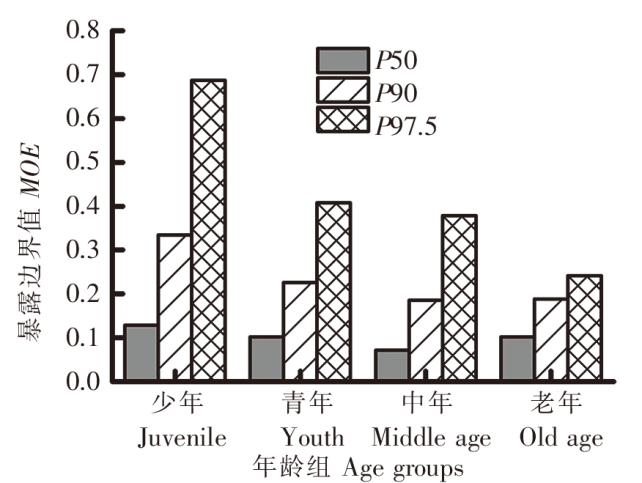
图2
不同年龄组摄食水产品镉健康风险
Fig.2
Cadmium health risk of cadmium intake in the aquatic products by different age groups
3 讨论
3.1 镉在水产品中的分布
所采集的6类水产品镉平均含量依次为头足类≈蟹类>贝类>藻类>虾类>鱼类。蟹类、头足类和贝类镉含量高,这与烟台市售水产品[8]、上海市售水产品[14]、福建中北部海域捕捞水产品[12]、阿尔及利亚及地中海西南部邻近水域[10]情况类似。养殖海水鱼类和虾类镉含量分别为(0.000 903±0.012 9)、(0.004 37±0.004 05)mg·kg-1,而捕捞海水鱼类和虾类分别为(0.014 3±0.015 5)、(0.027 9±0.017 6)mg·kg-1。捕捞鱼、虾与养殖品种镉含量差异显著(P<0.05),捕捞品种高约1个数量级。因此,认为这可能是由于养殖海水鱼、虾相对于捕捞品种生长速度快,而从环境和食物中累积的镉较少所致。海水蟹和淡水蟹镉含量分别为(0.512±0.375)、(0.117±0.089 3)mg·kg-1,海水蟹高于淡水蟹;贝类样品中牡蛎和蛤类镉含量分别为(0.464±0.197)、(0.051 3±0.045 2)mg·kg-1,牡蛎高于蛤类;头足类中鱿鱼和章鱼镉含量分别为(0.353±0.128)、(0.088 7±0.112) mg·kg-1,鱿鱼高于章鱼;藻类中海带和紫菜镉含量分别为(0.050 4±0.033 4)、(0.044 8±0.024 1)mg·kg-1,两者镉含量差异不大,结果表明水生动物对镉富集的程度与品种相关性强。这个结论印证了赵艳芳等[24]研究认为的水生动物对镉富集能力的差异主要在于其对镉解毒机制不尽相同的观点。同时,捕捞和养殖鱼、虾中镉含量的差异也说明水生动物生存条件会对镉的蓄积产生影响。
3.2 水产品中镉的主要来源
通过比较水产品摄入量与镉含量的乘积,得出各类水产品对总镉摄入量的贡献,结果见图3。所采集的6类水产品对镉摄入的贡献顺序为贝类>蟹类>头足类>藻类>鱼类>虾类。该顺序和这几类水产品镉平均含量顺序不同,这是由对各类水产品的摄入量不同所致。在各年龄组中,从鱼、虾摄入的镉仅分别占总镉摄入量的1.44%~4.46%和0.963%~3.96%,镉食用健康风险低;从贝类、蟹类和头足类分别占35.8%~61.7%、20.2%~28.4%和9.21%~23.5%,它们之和占总镉摄入量的85.8%~93.5%,因此这3类水产品是人体摄入镉的主要来源。
图3
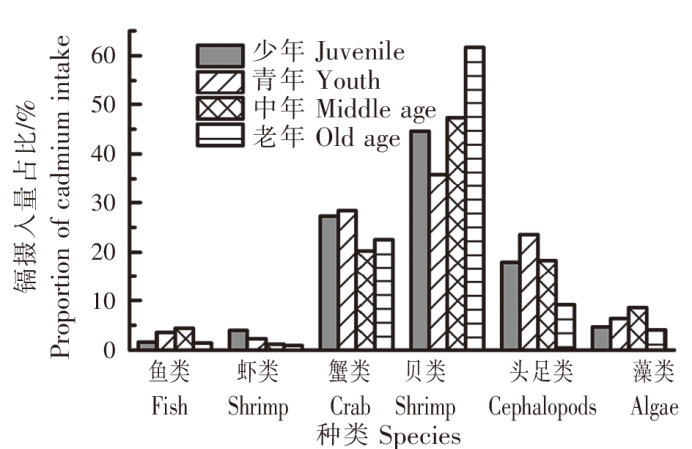
图3
人体从六类水产品中镉摄入量占比
Fig.3
Proportion of cadmium intake amount by human body from six categories of aquatic products
图4
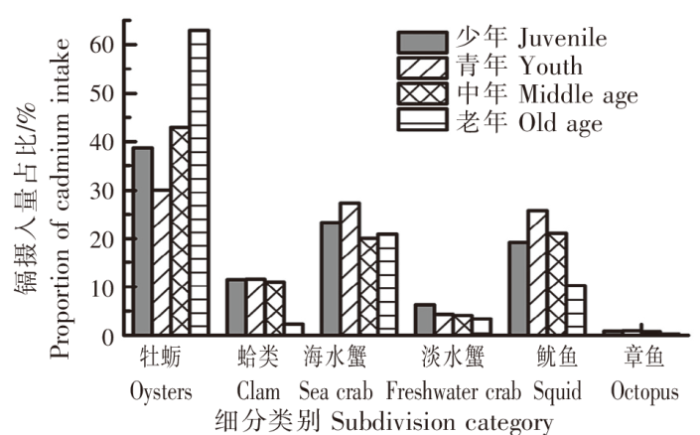
图4
人体从各细分类别水产品中镉摄入量占比
Fig.4
Proportion of cadmium intake amount by human body from aquatic products in various subdivision categories
3.3 降低水产品中镉食用健康风险的措施
水晶球软件根据各因素对结果的方差贡献,得出各类水产品镉含量变化对MOE变动的敏感度,如图5所示。在所监测的6类水产品中,各年龄组敏感度最高的均为贝类,在49.1%~83.4%之间,其次为蟹类,敏感度在15.7%~37.1%之间,这2项敏感度和达到86.2%~99.1%。鱼类、虾类、头足类和藻类等4类水产品敏感度和仅为0.946%~13.8%。因此在不改变摄食水产品各类别比例的情况下,多食用贝类和蟹类中镉含量较低的蛤类和淡水蟹,对降低水产品中镉食用健康风险可能有较明显的效果。头足类虽然是人体摄入水产品中镉的主要来源之一,但其含量变化对MOE值的变动影响小,在0.621%~10.8%之间,因此在食用头足类水产品时,可按自身的喜好进行选择、食用。
图5
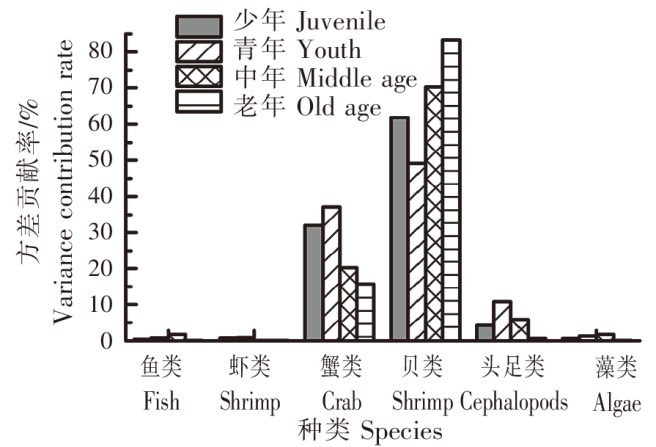
图5
六类水产品对MOE值的方差贡献
Fig.5
Variance contribution of MOE by six category aquatic products
食用蟹类和贝类时,多选择镉含量较低的品种,可降低食用健康风险。采用水晶球软件进行模拟验证,考察可降低风险值的程度。根据消费调查数据,贝类中牡蛎和蛤类消费比例分别约为35%和65%,蟹类中海水蟹和淡水蟹比例分别约为55%和45%。贝类和蟹类中镉含量较高的细分类别为牡蛎和海水蟹,分别按镉含量高类别占比下降5%、10%、15%、20%、25%(变动后各细分类别比例见表5)进行计算。
表5 贝类和蟹类中各细分类别消费比例
Tab.5
| 变动率/% Change rate | 贝类消费比例Ratio of shellfish consumption | 蟹类消费比例Ratio of crab consumption |
|---|---|---|
| 0 | 牡蛎∶蛤类=35%∶65% | 海水蟹∶淡水蟹=55%∶45% |
| 5 | 牡蛎∶蛤类=30%∶70% | 海水蟹∶淡水蟹=50%∶50% |
| 10 | 牡蛎∶蛤类=25%∶75% | 海水蟹∶淡水蟹=45%∶55% |
| 15 | 牡蛎∶蛤类=20%∶80% | 海水蟹∶淡水蟹=40%∶60% |
| 20 | 牡蛎∶蛤类=15%∶85% | 海水蟹∶淡水蟹=35%∶65% |
| 25 | 牡蛎∶蛤类=10%∶90% | 海水蟹∶淡水蟹=30%∶70% |
在不改变贝类和蟹类总摄入量的前提下,总体人群P50、P90和P97.5的MOE变化结果如图6所示。体现平均风险程度的P50数值变化不大,从0.093 1降低到0.069 0;体现绝大多数人群风险程度的P90降低了39.0%,从0.246降低到0.150;体现高暴露人群的P97.5降低了48.3%,从0.505降低到0.261。由此验证了选择食用镉含量较低的贝类和蟹类,可显著降低绝大多数和高暴露人群的镉食用健康风险。同时,结果也表明当比例改变到15%后,MOE值各百分位数趋向于稳定。因此,在进行膳食结构指导时,应提倡适当降低镉含量高水产品类别的摄入比例,不宜过度强调减少对海水蟹和牡蛎的消费。另外,赵艳芳等[24]、Bordon I C A C等[25]、Reichmuth J M等[26]分别对三疣梭子蟹、美青蟹(Callinectes danae)和蓝蟹(Callinectes sapidus Rathbum)体内重金属分布进行研究,结果表明蟹类消化腺中重金属蓄积浓度要远高于肌肉。因此,居民在摄食海水蟹时,应少食用蟹的肝胰腺和其他内脏部分。
图6
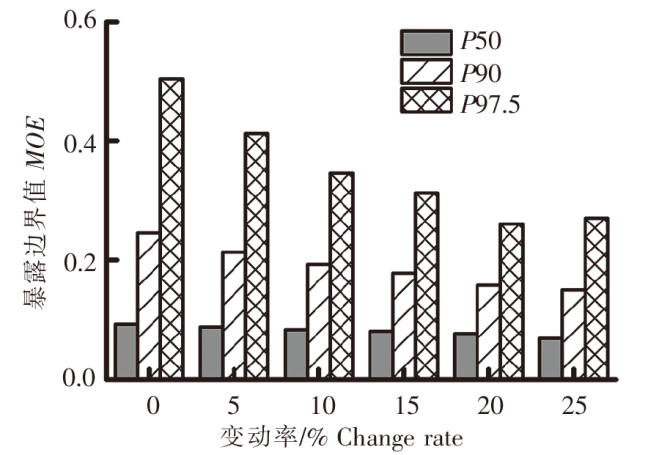
图6
改变贝类和蟹类消费结构对镉健康风险影响
Fig.6
Effect of changing the consumption structure of shellfish and crab on the health risk of cadmium
3.4 优化水产品中镉健康风险评估参数
当前,对水产品中镉的风险评估依据的毒理学数据主要为每月允许摄入量(PTMI)[13⇓⇓-16]或RfD[17⇓-19],这些数据的设定主要是根据小鼠摄入无机镉的毒性实验结果[23]。在生物体内,镉大部分与蛋白质、有机酸等结合形成稳定的有机镉[27],少部分以无机态存在[28],而有机态镉毒性远低于无机镉[29-30]。当前对水产品中镉风险评价仅测定总镉,并以毒性最高的无机镉作为评价标准,这在一定程度上高估了镉的风险。生物体内有机镉的检测主要应用色谱-质谱联用技术,采用高效液相色谱(HPLC)分别与电感耦合等离子质谱(ICP-MS)[31-32]、电喷雾串联质谱(ES-MS/MS)[33]、飞行时间质谱(ICP-TOF)[34]联用,但由于方法不够成熟,尚未形成标准检测方法。水生动物体内有机镉主要存在Cd-Mt(金属硫蛋白)、Cd-GSH(谷胱甘肽)、Cd-Cys(半胱氨酸)等形式[24],这些有机态镉的毒性在目前尚无统一的结论。同时,由于本次评估仅针对水产品,而镉在食物中广泛存在,如果考虑到其他食物的暴露风险,部分人群的风险值有可能超过可接受范围。GB 2762—2017 《食品安全国家标准 食品中污染物限量》对双壳类、头足类镉限量特别注明 “去除内脏”,本次评估采用的检测结果也是按去除内脏计,但贝类和头足类内脏中镉含量显著高于其他组织[35-36],人体在摄食这类水产品时也摄入了大部分内脏,这在一定程度上低估了镉的食用健康风险。因此对水产品中镉食用健康风险要作较准确的评估,还需对镉形态检测方法和毒理学等相关领域进一步深入研究。
4 结论
参考文献
Cadmium exposure in living organisms:a short review
[J].
Cadmium (Cd) is a toxic heavy metal that accumulates in living systems. Exposure can occur occupationally or environmentally. Workers within the electroplating, battery production, and pigment industries are at the highest risk for exposure and have been reported to have increased levels of Cd in their blood and urine. Environmental exposure can be the result of anthropogenic activities or smoking. Cd has a long half-life and bio accumulates in plants, invertebrates, and vertebrates. The toxic effects following exposure include growth retardation and organ system toxicity, with kidney and liver toxicity most reported with in higher organisms. At the molecular level, Cd leads to the production of reactive oxygen species, DNA damage, and inhibition of DNA repair. This article gives a brief overview of the correlations between exposure to cadmium occupationally and environmentally and levels measured in blood and urine. It also examines the bioaccumulation of cadmium in aquatic invertebrates and vertebrates indicating that accumulation varies not only by location but also within and between various species. (C) 2019 Elsevier B.V.
福建安海湾五种重金属和砷在不同介质中的分布特征研究
[J].据2014年5月和8月福建安海湾9个站位的调查资料,分析海水、水中悬浮物和表层沉积物中Cu、Pb、Zn、Cd、Hg等5种重金属和类金属As的含量及分布特征,用单因子指数法、潜在生态危害评价法评价湾内重金属污染程度。结果表明,海水分布从湾顶往湾内和湾口逐渐降低,以湾顶值最高;水中悬浮物Cu、Pb、Zn、As、Hg含量以AH5站最高,Cd含量以AH6站最高,并向周边逐渐降低;表层沉积物含量从AH5站向湾内及湾口逐渐降低。部分站位海水和沉积物中Cu、Zn含量相对偏高,Pb、Cd、As、Hg含量均符合海水及沉积物质量标准的第一类要求。安海湾海域不同介质中悬浮物的含量最高,表层沉积物次之,海水的含量最低。水中悬浮物8月含量潜在生态危害程度远大于5月,以AH5站的潜在生态危害程度最强,主要潜在生态危害元素为Cd和Hg;表层沉积物以AH1、AH5站的潜在生态危害程度稍强,主要潜在生态危害元素为Cd、Hg次之。安海湾海域环境受到不同程度的重金属污染,陆源重金属污染物排放成为主要来源,本研究为安海湾海域生态环境防治提供科学依据。
Heavy metal concentrations in aquatic organisms (fishes,shrimp and crabs) and health risk assessment in China
[J].
Accumulation of heavy metals in fishes:a human health concern
[J].
Field accumulation risks of heavy metals in soil and vegetable crop irrigated with sewage water in western region of Saudi Arabia
[J].
Studies on seasonal pollution of heavy metals in water,sediment,fish and oyster from the Meiliang Bay of Taihu Lake in China
[J].The present study, seasonal pollution of heavy metals (Pb, Cd, Cr and Cu) in water, sediment, tissues of fish Carassius carassius and oyster Crassostrea gigas were determined at seven sampling sites from Meiliang Bay, Taihu Lake during one year calendar, 2016. The total heavy metal concentrations in water samples were higher in winter and summer than in spring and autumn season, whereas in sediment they were higher in winter and summer seasons, respectively. The trend of metal mean contents found in the fish and oyster were in decreasing order of Pb > Cu > Cr > Cd and Pb > Cu > Cr > Cd, respectively. The tissues of fish and oyster captured during winter and summer accumulated a higher significant different amount of metals relative to other season, which was attributed to a higher influx of agricultural waste, sewage and sludge by heavy rainfall and floods. In addition, the pollution load index (PLI) values were above one (>1), indicating an advanced decline of the sediment quality, and contamination factor (CF) confirmed that the sediment samples were moderate to high contamination by Pb and Cr. Thus, comparative studies with seasonal pollution of heavy metals in Meiliang Bay of Lake Taihu regions indicate considerable heavy metal enrichment in water, sediments as well as in various organs of fish and oyster. Finally, our results indicated that the metal concentration values increased statistically significant different related to season (p < 0.001). The determination of heavy metal stress biomarkers in fish along with seasonal variations may serve as a convenient approach during pollution bio-monitoring programme.Copyright © 2017 Elsevier Ltd. All rights reserved.
Review of the toxic trace elements arsenic,cadmium,lead and mercury in seafood species from Algeria and contiguous waters in the Southwestern Mediterranean Sea
[J].
福建中东部海水养殖贝类质量现状与评价
[J].通过对2014—2018年在福建中东部共1 265批次贝类样品开展的卫生监测抽检的数据进行分析,并利用《2018年海水贝类产品卫生监测检测项目、方法及限量值》对贝类质量安全水平进行评估,结果表明:监测区域内的海水养殖贝类样品大多符合一类生产区标准,部分符合二类生产区标准,少量符合三类生产区标准,总体处于较好水平。监测的太平洋牡蛎、缢蛏、菲律宾蛤仔、贻贝、美洲帘蛤、文蛤6 种养殖贝类中缢蛏对铅的富集能力高于其他品种,而太平洋牡蛎和贻贝对镉的富集能力较其他品种相对较强。
福建省中北部海域捕捞水产品中4种重金属含量与风险评价
[J].为了解福建省中北部海域捕捞水产品的重金属污染现状及摄入风险,分别于2014年和2015年采集了该区域的鱼类和甲壳类,共18种160个主要水产品,调查研究了铅、镉、总汞和无机砰4种重金属的含量,并采用单因子污染指数(Pi、重金属污染指数(MPI)、每周可耐受摄入量(PTWI) 和致癌、非致癌年风险(Rcig 、Rnig) 指标分别评价捕捞水产品的污染程度、食用安全性和健康风险。研究结果表明,目前福建中北部海域捕捞水产品中铅、总汞和无机砰都符合国家标准规定,但重金属镉存在污染,超标率为9.4% ; Pi结果显示,鱼类受重金属污染影响不显著,基本上处于正常范围内,甲壳类中口虾蛄和梭子蟹中镉含量达到重污染水平,其他重金属含量处于正常范围内;MPI结果显示,甲壳类重金属污染高于鱼类;食用安全评价表明,通过食用捕捞水产品摄入的4种重金属平均含量均低于每周可耐受摄入量,但个别甲壳类(梭子蟹和口虾蛄)的镉摄入量超过了PTWI (成人)值,存在较高风险;健康风险模型结果显示,所有样品均未超过国际辐射防护委员会(ICRP) 推荐的最大可接受水平(5. 0 x l0 -5a -1 ) 。总体上看,当前,福建省捕捞水产品可放心食用,但是重金属镉的潜在食用安全风险需引起重视。
Concentrations of lead,cadmium and mercury in sardines,Sardina pilchardus (Walbaum,1792) from the Algerian coast and health risks for consumers
[J].
Potential health risk caused by heavy metal associated with seafood consumption around coastal area
[J].
Fish tissue quality in the lower Mississippi River and health risks from fish consumption
[J].Between 1990 and 1994, samples of three shellfish species (i.e. blue crab, Callinectes sapidus;crayfish, Procambarus acutis; and river shrimp, Macrobrachium ohionii) and 16 fish species and were collected at six sites along the lower Mississippi River by the Louisiana Department of Environmental Quality, Office of Water Resources in coordination with the US Environmental Protection Agency. The fish species included: bigmouth buffalo (Ictiobus cyanellus); blue catfish (Ictalurus furcatus); carp (Cyprinus carpio); channel catfish (Ictalurus punctatus); cobia (Rachycentron canadum); flathead catfish (Pylodictis olivaris); freshwater drum (Aplodinotus grunniens); largemouth bass (Micropterus salmoides); long nose gar (Lepisosteus osseus); red drum (Sciaenops ocellatus); red snapper (Lutjanus campechanus); smallmouth buffalo (Ictiobus bubalus); spotted gar (Lepisosteus oculatus); striped bass (Morone saxatilis); white bass (Morone chrysops); and white crappie (Pomoxis annularis). Organic compound and heavy metal concentrations were measured in 161 composite fish tissue samples where each composite included three to 10 individual fish. Nineteen chemicals, found at measurable levels in sample tissues, were used in calculations of lifetime excess cancer and non-cancer risks due to fish consumption. We calculated: 574 chemical-specific cancer risks; 41 total cancer risks; and 697 margins of exposure based on a consumption rate of one 8-ounce meal per week (0.032 kg/day), a body weight of 70 kg and reported cancer potency factors and reference doses. We identified nine species of concern (blue catfish, carp, channel catfish, cobia, crayfish, flathead catfish, red drum, spotted gar and striped bass) based on total cancer risk greater than 10(-4) or margin of exposure greater than 1, and whether or not samples collected in subsequent years resulted in lower risks. The compounds primarily responsible for the elevated risks were aldrin, dieldrin, alpha-benzene hexachloride, gamma-benzene hexachloride, heptachlor epoxide, arsenic and mercury.Copyright 2002 Elsevier Science B.V.
IRIS Assessments (Cadmium)
[EB/OL].(
A preliminary assessment of metal bioaccumulation in the blue crab,Callinectes danae from the Sao Vicente Channel,Sao Paulo State,Brazil
[J].
Bioaccumulation and depuration of metals in blue crabs (Callinectes sapidus Rathbun) from a contaminated and clean estuary
[J].Blue crabs from a contaminated estuary (Hackensack Meadowlands-HM) and a cleaner reference site (Tuckerton-TK) were analyzed for Cr, Cu, Hg, Pb, and Zn in muscle and hepatopancreas. Crabs from each site were taken into the laboratory and fed food from the other site, or in another experiment, transplanted to the other site for eight weeks. All crabs were analyzed for metals. Overall, tissue concentrations reflected environmental conditions. Tissue differences were found for Cu, Pb and Zn (all higher in hepatopancreas), and Hg (higher in muscle). HM muscle had more Hg than TK muscle, but did not decrease after transplanting or consuming clean food. HM crabs lost Cu, Pb and Zn in hepatopancreas after being fed clean food or transplanted. TK crabs increased Hg in muscle and Cr and Zn in hepatopancreas after transplantation or being fed contaminated (HM) food. Concentrations were variable, suggesting that blue crabs may not be fully reliable bioindicators of polluted systems.Copyright (c) 2009 Elsevier Ltd. All rights reserved.
Cadmium sorption,influx,and efflux at the mesophyll layer of leaves from ecotypes of the Zn/Cd hyperaccumulator Thlaspi caerulescens
[J].
A new method for evaluating the bioaccessibility of different foodborne forms of cadmium
[J].The bioabsorption and biotoxicity of cadmium are closely related to its binding form. Currently, total concentration is used as the indicator for evaluating cadmium toxicity in food, but it might not accurately reflect cadmium's toxic effects. This study attempted to evaluate the toxicity of the different forms of cadmium including cadmium-malate, cadmium-glutathione, and cadmium-metallothionein that are commonly found in food. The in vitro physiologically based extraction test (PBET) combined with Visual MINTEQ modeling was used to predict the toxicity of different forms of cadmium, and acute toxicity testing was performed in mice for validating their results. The in vivo experimental results showed that different forms of cadmium had diverse biotoxicities of which PBET was a good predictor. In particular, the simulation of cadmium ions in PBET using the MINTEQ software revealed that the free cadmium ion content in the simulated intestinal fluid had a superior linear relationship than the total cadmium concentration with the toxicology indexes. Verification using the other two forms of cadmium confirmed the accuracy of the prediction of their biotoxicity. These findings hopefully provide an important reference for a more accurate and rapid safety assessment of cadmium in food.Copyright © 2019 Elsevier B.V. All rights reserved.
Metal speciation of metallothionein in white sea catfish,Netuma barba,and pearl cichlid,Geophagus brasiliensis,by orthogonal liquid chromatography coupled to ICP-MS detection
[J].Metal speciation analysis in MTs was carried out in two tropical fish species of Brazil, the freshwater fish pearl cichlid (Geophagus brasiliensis) and the marine fish white sea catfish (Netuma barba), that are presently used to monitor the effects of heavy metal pollution in aquatic ecosystems in Brazil. In order to obtain the MT fraction, liver cytosols from both fish species where subjected to size exclusion fractionation, monitoring on-line the metal signal (Cd, Cu and Zn) by ICP-MS while protein elution was followed by on-line UV detection. That MT fraction was then separated by anion-exchange (AE)-FPLC, whose optimal chromatographic conditions were optimized for the separation of the different hepatic MT isoforms existing in both fish species. Specific detection of separated metalloforms was carried out again by the hyphenation of the AE chromatographic system with the ICP-MS instrument. The analytical results showed that MTs of these fish species, unknown so far, exhibited unique characteristics in comparison with standard MTs and other fish liver MTs. In fact, MT isoforms of N. barba turned out to be very anionic, as indicated by their high retention in the Mono Q column and the strong ionic strength required to separate them. As for G. brasiliensis, cadmium was exclusively present in only one of the peaks of the MT isoforms showing a unique metal-binding behavior for MT in this fish species. The differences between the MTs among these species and the different association of metals in particular MT isoforms display the importance of the metal speciation analysis in these proteins prior to its use as bioindicators.
Identification of cadmium-bioinduced ligands in rat liver using parallel HPLC-ICP-MS and HPLC-electrospray MS
[J].
A field survey of metal binding to metallothionein and other cytosolic ligands in liver of eels using an on-line isotope dilution method in combination with size exclusion (SE) high pressure liquid chromatography (HPLC) coupled to inductively coupled plasma time-of-flight mass spectrometry (ICP-TOFMS)
[J].The effect of metal exposure on the accumulation and cytosolic speciation of metals in livers of wild populations of European eel with special emphasis on metallothioneins (MT) was studied. Four sampling sites in Flanders showing different degrees of heavy metal contamination were selected for this purpose. An on-line isotope dilution method in combination with size exclusion (SE) high pressure liquid chromatography (HPLC) coupled to Inductively Coupled Plasma time-of-flight Mass Spectrometry (ICP-TOFMS) was used to study the cytosolic speciation of the metals. The distribution of the metals Cd, Cu, Ni, Pb and Zn among cytosolic fractions displayed strong differences. The cytosolic concentration of Cd, Ni and Pb increased proportionally with the total liver levels. However, the cytosolic concentrations of Cu and Zn only increased above a certain liver tissue threshold level. Cd, Cu and Zn, but not Pb and Ni, were largely associated with the MT pool in correspondence with the environmental exposure and liver tissue concentrations. Most of the Pb and Ni and a considerable fraction of Cu and Zn, but not Cd, were associated to High Molecular Weight (HMW) fractions. The relative importance of the Cu and Zn in the HMW fraction decreased with increasing contamination levels while the MT pool became progressively more important. The close relationship between the cytosolic metal load and the total MT levels or the metals bound on the MT pool indicates that the metals, rather than other stress factors, are the major factor determining MT induction.
Metal bioaccumulation and detoxification processes in cephalopods:a review
[J].
Effect of cooking temperatures on chemical changes in species of organic arsenic in seafood
[J].
Effects of various cooking processes on the concentrations of arsenic,cadmium,mercury,and lead in foods
[J].
 表1
表1 图1
图1


